

 Available 24/7

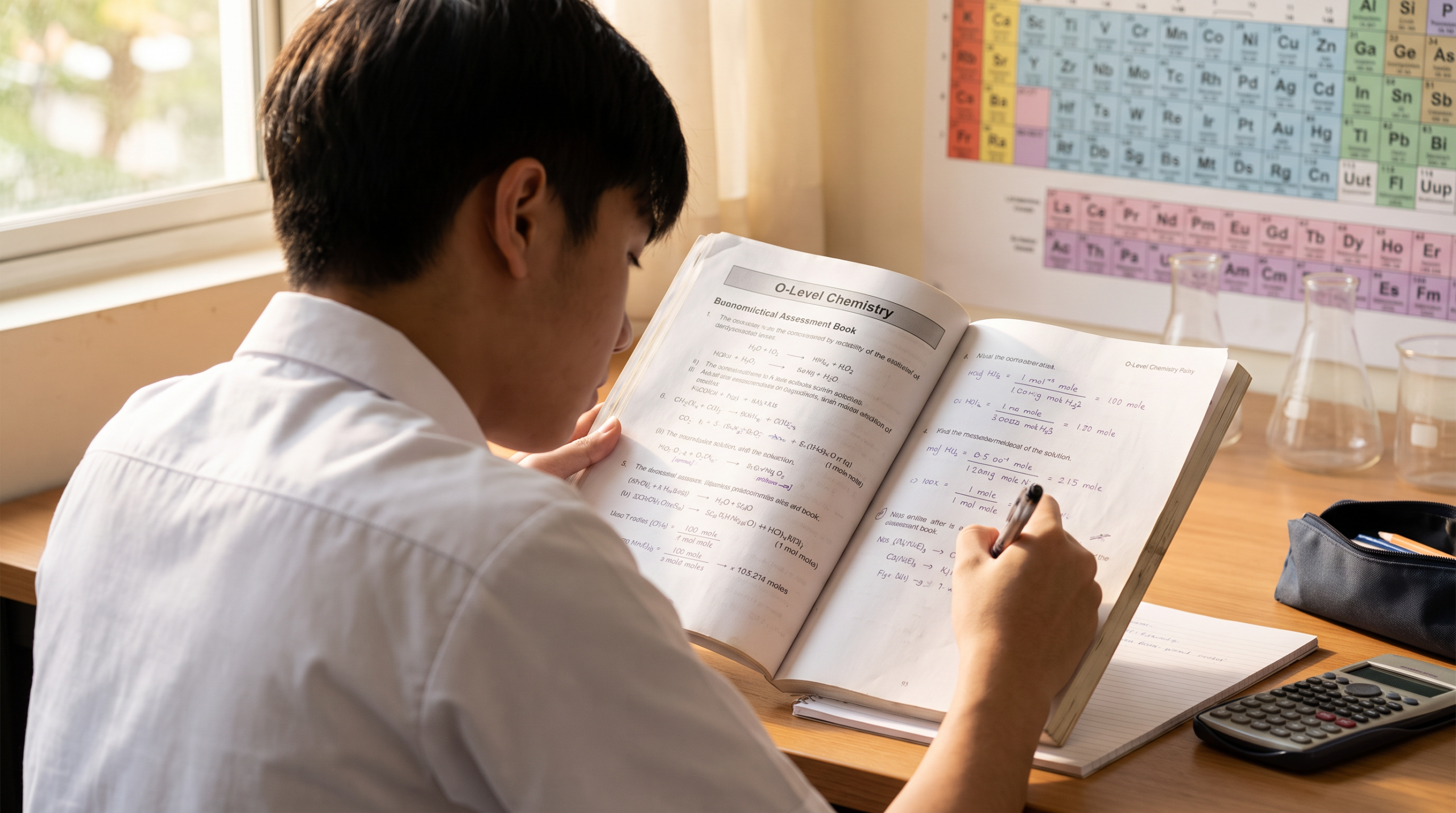
The O-Level Chemistry syllabus (6092, which becomes K324 under the 2027 SEC) has 12 topics in three sections: Matter, Chemical Reactions, and Chemistry in a Sustainable World. It is examined in three papers: a 1-hour multiple-choice paper, a 1 h 45 min structured paper and a 1 h 50 min practical.
O-Level Chemistry Syllabus (6092 / K324): Every Topic
This is the full content outline from the SEAB syllabus document for Pure Chemistry. SEAB lists K324 as the 2027 code for the subject that was 6092, and its 2027 G3 syllabus page does not mark Chemistry as revised. The 2026 and 2027 documents carry the same 12 topics and the same three papers, so a student in Sec 3 now is learning the content they will be examined on.
| Section | Topic | What it covers |
|---|---|---|
| I. Matter: Structures and Properties | 1. Experimental Chemistry | Apparatus and experimental design; purification and analysis, including chromatography and Rf values, and melting and boiling points as tests of purity |
| 2. The Particulate Nature of Matter | Kinetic particle theory and diffusion; atomic structure, proton and nucleon numbers, isotopes | |
| 3. Chemical Bonding and Structure | Ionic, covalent and metallic bonding; giant structures, simple molecules, diamond and graphite, alloys | |
| II. Chemical Reactions | 4. Chemical Calculations | Relative atomic and molecular mass, the mole and the Avogadro constant, reacting masses, concentration |
| 5. Acid-Base Chemistry | pH, strong and weak acids, neutralisation; salt preparation, solubility, precipitation and titration; ammonia and the Haber Process | |
| 6. Qualitative Analysis | Tests for cations (including NH4+, Cu2+, Fe2+, Fe3+, Zn2+), anions (carbonate, chloride, iodide, nitrate, sulfate) and gases | |
| 7. Redox Chemistry | Oxidation and reduction; electrochemistry, including electrolysis, simple cells and fuel cells | |
| 8. Patterns in the Periodic Table | Group 1, Group 17, Group 18 and the transition elements; the reactivity series, extraction of metals, rusting | |
| 9. Chemical Energetics | Exothermic and endothermic reactions; bond breaking and bond making | |
| 10. Rate of Reactions | Collision theory, factors that change the rate, catalysts and enzymes | |
| III. Chemistry in a Sustainable World | 11. Organic Chemistry | Alkanes, alkenes, alcohols and carboxylic acids as homologous series; esters; polymers |
| 12. Maintaining Air Quality | Pollutants (CO, SO2, nitrogen oxides, methane, unburned hydrocarbons, ozone), acid rain, ozone depletion by CFCs, greenhouse gases |
Students taking Chemistry inside Combined Science sit a different syllabus (K326 for Physics and Chemistry, K328 for Chemistry and Biology) with its own papers. Our guide to Pure Science vs Combined Science sets out the difference.
How the O-Level Chemistry Papers Are Structured
| Paper | Format | Time | Marks | Weighting |
|---|---|---|---|---|
| Paper 1 | 40 compulsory multiple-choice questions | 1 h | 40 | 30% |
| Paper 2 | Section A: compulsory structured questions (70 marks), the last two worth 20 marks between them and including a data-based question. Section B: answer one of two questions (10 marks) | 1 h 45 min | 80 | 50% |
| Paper 3 | Practical exam, including qualitative analysis | 1 h 50 min | 40 | 20% |
Across the two theory papers, SEAB puts about 45% of marks on knowledge with understanding and about 55% on handling information and solving problems. More than half the theory marks therefore go to applying chemistry to unfamiliar data, which is why memorising notes is not enough on its own. The topics where that shows most are covered in the five O-Level Chemistry topics that trip students up most.
Which Chemistry Topics Come in Sec 3 and Which in Sec 4
MOE and SEAB do not split the syllabus by year. Each school sets its own order, so treat the table below as a typical pattern, drawn from the published Express schemes of work at Woodgrove Secondary (2022) and Peicai Secondary, not a rule.
| Usually in Sec 3 | Usually in Sec 4 |
|---|---|
| Kinetic particle theory, separation and purification, atomic structure | Redox and electrolysis |
| Ionic, covalent and metallic bonding | Energy changes (chemical energetics) |
| The Periodic Table | Rate of reactions |
| Acids, bases and salts, including titration | Ammonia (some schools start it at the end of Sec 3) |
| Metals and the reactivity series (some schools carry this into Sec 4) | Organic chemistry and macromolecules, usually Terms 2 and 3 |
The practical consequence is that Sec 4 brings most of the abstract content (electrons in redox and electrolysis, energy, rates, and the whole of organic chemistry) into the same year as prelims. Anything left shaky from Sec 3, especially moles and bonding, has to be repaired at the same time. For the same breakdown in Physics, see the O-Level Physics syllabus.
Result: Shi En went from C6 to A1 in Combined Science (Chemistry and Biology) at the 2025 O-Levels. Our classes take five students at most. See how we teach it on our O-Level Chemistry tuition page.
Sec 3 vs Sec 4 Chemistry: What Each Year Demands
A parent whose child is about to enter Sec 3 Chemistry asked a question that a lot of parents silently wonder about: should we get tuition now, or wait until Sec 4 when the pressure really builds? It is a reasonable question, and the answer is not intuitive unless you understand what the two years actually look like from the inside.
Sec 3 and Sec 4 Chemistry are not the same experience. They make different demands, create different kinds of difficulty, and respond to different kinds of support. Understanding how they differ is the key to making good decisions about when to intervene and what kind of help your child actually needs.
Sec 3 Chemistry: Where Foundations Are Built and Misunderstandings Form
Sec 3 is the year when students encounter Chemistry in its upper-secondary form for the first time. The content introduced here is foundational in the most literal sense: almost everything that appears in Sec 4 builds directly on it.
The Mole Concept is introduced in Sec 3 and is immediately load-bearing. Every quantitative chemistry calculation in Sec 4 — stoichiometry, solution concentration, titration, and yield calculations — depends on students being fluent with moles. A student who leaves Sec 3 with a fragile understanding of the Mole Concept will find Sec 4 quantitative chemistry systematically difficult, often without being able to identify why.
Atomic Structure and Chemical Bonding, also Sec 3 topics, set the foundation for understanding why substances have the physical properties they do, why some compounds dissolve in water and others do not, and why certain reactions proceed while others do not. These are not abstract topics; they are the explanatory framework that Chemistry students use throughout Sec 4.
The distinctive feature of Sec 3 Chemistry is that students have time. There are two years before the O-Level examination, and teachers can move at a pace that allows genuine understanding to develop. This is the only year in which truly understanding a concept before moving on is realistic — which is also why misunderstandings that form in Sec 3 are so damaging. They tend to go undetected until Sec 4, when the student struggles with what appears to be Sec 4 content but is actually a Sec 3 foundation problem.
The Sec 3 Topics That Determine Sec 4 Performance
Beyond the Mole Concept, several Sec 3 topics consistently predict Sec 4 outcomes:
- Acids, bases and salts: pH, neutralisation, strong and weak acids, and choosing a salt preparation method, with titration calculations that depend on the mole.
- Metals and the reactivity series: where each metal sits and why, which Sec 4 redox and electrolysis questions build on directly.
- Chemical Equations — the ability to balance equations correctly and write ionic equations, required in nearly every quantitative question throughout Sec 4.
- Chemical bonding and structure: explaining melting point, conductivity and solubility from structure, a skill Sec 4 reuses for organic compounds and macromolecules.
Students who secure these four areas in Sec 3 enter Sec 4 with a real structural advantage. Students who have not tend to find Sec 4 Chemistry genuinely overwhelming — not because the new content is impossibly hard, but because they are simultaneously trying to fill Sec 3 gaps while absorbing new material.
Sec 4 Chemistry: Application Under Pressure
If Sec 3 is the year when foundations are built, Sec 4 is the year those foundations are tested under conditions of increasing pressure and decreasing time.
Sec 4 Chemistry is not a full teaching year. After factoring in school holidays, preliminary examinations, and the O-Level examination itself, students have significantly less time than in Sec 3. The content introduced in Sec 4 includes Organic Chemistry in full, Electrolysis, Ammonia and the Haber Process (for Pure Chemistry students), and deeper Redox Chemistry. These are not lightweight additions.
The quality of Sec 3 preparation is brutally exposed in Sec 4. Students who arrive with secure foundations can absorb new content at pace and still have time for thorough exam preparation. Students who arrive with gaps discover that filling those gaps while learning new content simultaneously is genuinely very hard to do. Prevention in Sec 3 is more efficient than recovery in Sec 4.
If your child is in Sec 4 and facing this challenge right now, our guide on how to score A1 in O-Level Chemistry through Organic Chemistry mastery gives a targeted revision framework.
When Students Seek Help Too Late
The most common pattern in O-Level Chemistry tuition requests is that parents make contact in Term 1 or Term 2 of Sec 4, usually after a disappointing preliminary or mid-year result. At this point the student typically has between four and eight months before the O-Level examination.
Four to eight months is not nothing. Students who commit fully to structured tuition in this window can and do improve significantly. But the improvement is harder to achieve, and requires greater intensity, than it would have if the same support had begun in Sec 3. The students who achieve the most dramatic improvements in this timeframe tend to share three characteristics: they accept a full diagnosis of their Sec 3 gaps rather than focusing only on Sec 4 content, they practise past papers under exam conditions from early in the process, and they develop the discipline to review mark schemes in detail rather than simply doing more questions.
How to Structure Chemistry Support Across Both Years
The most effective model looks like this: structured support beginning in Sec 3 focused on foundation topics, with a clear diagnostic check at the end of Sec 3 to confirm which areas are secure and which need attention before Sec 4 begins, followed by a Sec 4 programme that addresses any remaining gaps early and transitions to exam preparation by Term 3.
This requires a programme that tracks progress across both years and adapts its focus accordingly — the opposite of a programme that simply follows the school syllabus, adding one more lesson per week without a broader view of the student’s chemistry trajectory. Parents who want to see how this works in practice will find an overview on our O-Level Chemistry tuition page.
Ready to get started? Explore our O-Level Chemistry Tuition programme
Starting Sec 3 or Sec 4 Chemistry?
Our Pure Chemistry and Combined Science classes take five students at most, at our Hougang centre, Blk 208 Hougang Street 21, #04-215, near Kovan MRT. We check the Sec 3 foundations first, then teach the topics your child’s school is on.
O-Level Chemistry tuition · Combined Science tuition · Book a trial lesson →
Frequently Asked Questions
How many topics are in the O-Level Chemistry syllabus?
Twelve, in three sections. Matter: Structures and Properties has Experimental Chemistry, The Particulate Nature of Matter, and Chemical Bonding and Structure. Chemical Reactions has Chemical Calculations, Acid-Base Chemistry, Qualitative Analysis, Redox Chemistry, Patterns in the Periodic Table, Chemical Energetics and Rate of Reactions. Chemistry in a Sustainable World has Organic Chemistry and Maintaining Air Quality.
Is the K324 Chemistry syllabus different from 6092?
Not in content. K324 is the code Chemistry takes under the Singapore-Cambridge Secondary Education Certificate from 2027, and SEAB lists 6092 as its earlier code without marking it as revised. Both documents have the same 12 topics and the same three papers, at 1 h, 1 h 45 min and 1 h 50 min.
When is the best time to start Chemistry tuition, Sec 3 or Sec 4?
Sec 3 is significantly better. Starting in Sec 3 lets a tutor build foundations correctly from the outset rather than diagnosing and repairing gaps in Sec 4 while simultaneously covering new content. If your child is already in Sec 4, starting immediately is still worth doing.
My child passed Sec 3 Chemistry. Does that mean they are ready for Sec 4?
Passing is a necessary but not sufficient indicator. The question to ask is which specific Sec 3 topics your child understands deeply and which they have only partially grasped. A B4 with weak Mole Concept understanding is a very different situation from a B4 with strong fundamentals and one or two specific topic gaps.
What should Sec 3 Chemistry tuition focus on?
The Mole Concept, Chemical Bonding, Acids and Bases, and the ability to write balanced equations accurately. These four areas underpin the vast majority of Sec 4 content and exam questions.
How does the school’s internal assessment affect O-Level preparation?
School results (term tests, mid-years, preliminary exams) do not contribute to the O-Level grade directly, but they are useful diagnostics. Their value is in identifying gaps early. A student who scores poorly on a Sec 3 mid-year paper should treat that result as a signal to address specific topics immediately rather than hoping the next term will be better.
Is online or in-person Chemistry tuition better for Sec 3 and Sec 4 students?
For Chemistry, in-person tuition has a significant advantage because practical-experiment discussions, diagram work, and equation writing are much more naturally interactive in a physical setting. Online tuition can supplement but tends to be less effective as a primary support mechanism, particularly for students who are already struggling.
Sec 3 and Sec 4 Chemistry are two chapters of the same story. Students who treat Sec 3 as the foundation year and Sec 4 as the application year, and who receive the right support at each stage, are consistently the ones who arrive at the O-Level examination well-prepared.
Find out how Arche Academy supports students across both years by booking a trial class today.