

 Available 24/7
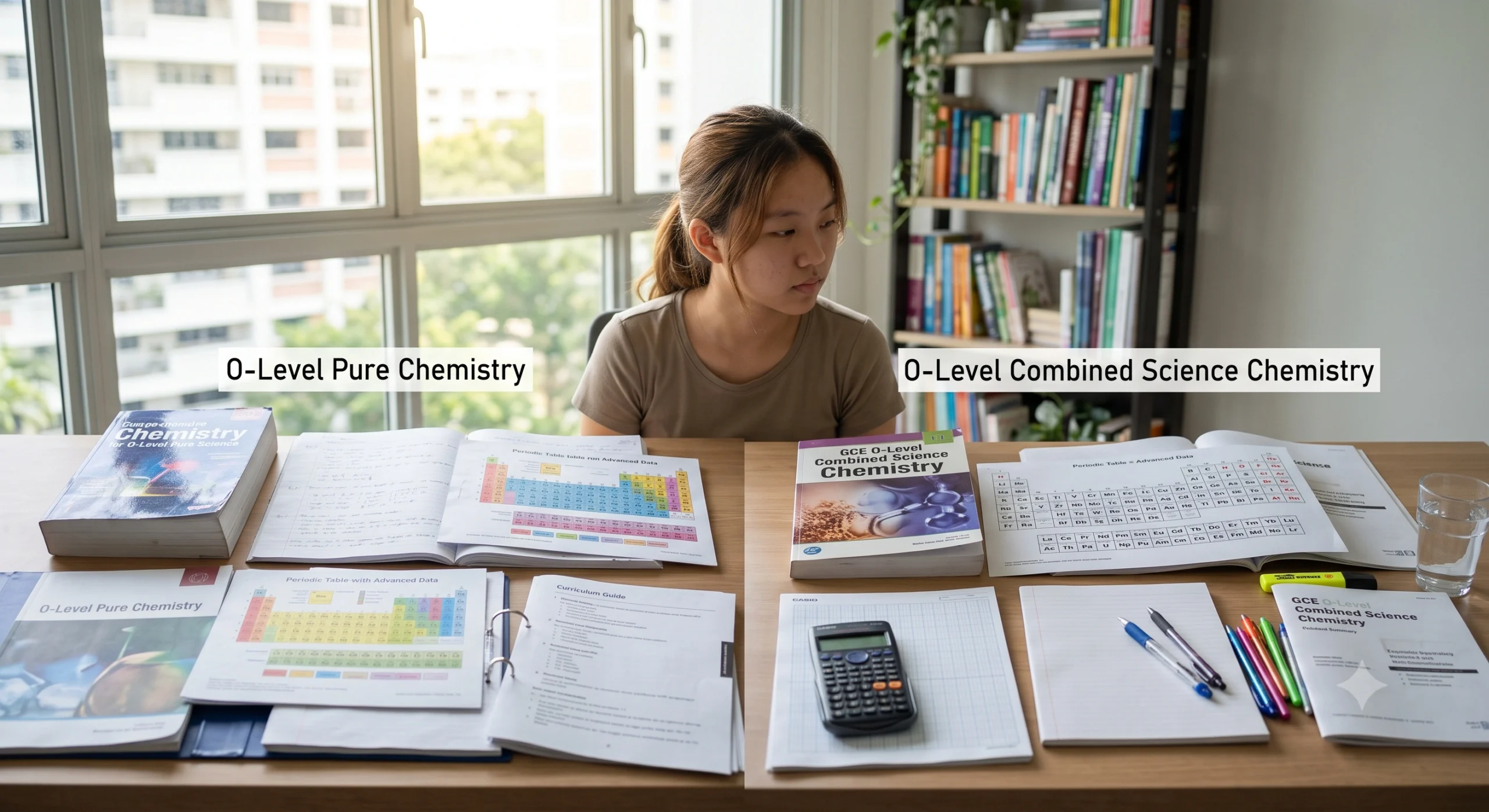
Every year, parents of Sec 2 students face one of the more consequential decisions in the Singapore school system: which science subject combination should their child take for the O-Levels? For many families, the sharpest point of confusion is the distinction between Pure Chemistry and Combined Science Chemistry. They look similar on the surface. They are not.
This guide explains the structural differences between the two options, what each demands from students, and how the choice plays out in terms of grades, JC admission, and university pathways. The goal is to give parents the information they need to make a confident, informed decision before Sec 3 begins.
What Pure Chemistry and Combined Science Chemistry Actually Are
Pure Chemistry at O-Level is a standalone subject. A student who takes Pure Chemistry sits for a dedicated Chemistry examination and receives a separate O-Level grade for that subject. The syllabus covers the full Chemistry curriculum as defined by SEAB (syllabus 6092).
Combined Science is a different structure altogether. A student taking Combined Science studies two science subjects simultaneously, typically Physics and Chemistry, or Chemistry and Biology. Together, they count as a single O-Level subject, yielding one combined grade. Each component covers approximately half the depth of the corresponding Pure Science.
The practical consequence of this distinction is significant: a student taking Pure Physics and Pure Chemistry has two separate O-Level grades available. A student taking Combined Science Physics/Chemistry has only one. This single structural difference has downstream effects on L1R5 aggregates and JC admission.
If your child is weighing up the Combined Science route, our overview of O-Level Combined Science covers the full structure in detail.
How Deep Does the Syllabus Go? Pure Chemistry vs Combined Chemistry
Pure Chemistry covers approximately 25 to 30 percent more content than the Chemistry component of Combined Science. The additional topics in Pure Chemistry include Metallic Bonding, Salts and Salt Preparation in full, Ammonia and the Haber Process, deeper Oxidation and Reduction, Electrochemistry, Transition Elements, and Maintaining Air Quality.
Combined Science Chemistry covers the same core topics (Atomic Structure, Chemical Bonding, Mole Concept, Organic Chemistry, Acids and Bases) but with reduced depth and fewer of the more advanced extensions. For a student who enjoys Chemistry, this reduced depth can feel limiting. For a student who finds Chemistry challenging, it can make the subject more manageable within the context of studying two sciences simultaneously.
The grading system differs as well. Pure Chemistry is graded A1 to F9 as an individual subject. Combined Science is graded differently: the two components are combined into a single score, which is then mapped to a grade. This means that a student who is stronger in one component and weaker in the other will have their result averaged, which works in their favour if the stronger component pulls up the weaker one.
How the Choice Affects L1R5 and JC Admission
For students aiming at Junior College, the L1R5 aggregate (English plus five relevant subjects) determines JC options. The critical point here is the number of grades available to optimise the aggregate.
A student taking Pure Physics and Pure Chemistry has two separate subject grades, each of which can contribute to the L1R5 calculation independently. A student taking Combined Science Physics/Chemistry has only one combined grade to use from their science subjects. This is not necessarily a disadvantage if that grade is strong, but it reduces flexibility in aggregate calculation.
Students who are strong in Sciences and want to maximise their L1R5 aggregate generally benefit from taking Pure Sciences. Students who need to balance their science workload with Humanities or who have a particular strength in one science but not the other may find Combined Science a more strategic choice.
For students who are already in Sec 3 and studying Combined Science, our guide on how to choose the right Combined Science tuition programme gives practical direction.
Which Student Profiles Suit Each Option
Pure Chemistry suits students who genuinely enjoy Chemistry as a subject, who are comfortable managing a higher content load, and who are planning for JC pathways that require strong Science grades. Students targeting Medicine, Engineering, or Chemical Sciences at university typically need strong Pure Chemistry results.
Combined Science Chemistry suits students who enjoy science but are more evenly distributed across subjects, who are uncertain about their JC pathway, or who want to balance their O-Level subjects more manageably across multiple disciplines. It is not a weaker option but a different one, designed for a different academic profile.
A useful question to ask: what does your child plan to study after O-Levels? If the pathway requires H2 Chemistry at JC, Pure Chemistry is generally the stronger foundation. If the pathway is more flexible or points toward Polytechnic, Combined Science may be entirely sufficient.
Can a Combined Science Student Take H2 Chemistry at JC?
This is one of the most common questions parents ask, and the answer is: sometimes, yes, but with conditions. Most JCs set subject prerequisites for H2 Science subjects. For H2 Chemistry, the typical requirement is a strong grade in O-Level Pure Chemistry or a very strong grade in Combined Science.
Students who took Combined Science and received a high grade (typically B3 or above) may be allowed to take H2 Chemistry at JC, but this varies by institution and is not guaranteed. Students who took Pure Chemistry with a strong result have a significantly smoother pathway into H2 Chemistry.
The implication for decision-making in Sec 2: if there is any realistic chance your child will want to pursue H2 Chemistry, Pure Chemistry is the safer choice. It keeps more doors open.
If your child has already committed to Combined Science and wants to build the strongest possible foundation in both components, see how Arche Academy’s O-Level Combined Science tuition programme is structured.
Ready to get started? Explore our O-Level Chemistry Tuition options
Frequently Asked Questions
Is Combined Science easier than Pure Chemistry?
Combined Science covers less depth in each component, which makes individual sections more manageable. However, studying two science subjects simultaneously has its own demands. Whether it is easier depends on the student’s strengths and how they manage their study time.
Does a Combined Science grade count the same as a Pure Science grade in the L1R5?
Combined Science counts as one subject in the L1R5 aggregate, whereas Pure Chemistry and Pure Physics each count as separate subjects. This structural difference is why students taking Pure Sciences have more grades available to optimise their aggregate.
My child is strong in Chemistry but weak in Physics. Should they take Combined Science or Pure Chemistry alone?
If your child is strong in Chemistry and wants to maximise that strength for JC, Pure Chemistry is the better choice. Combined Science averages the two components, which means a weak Physics component will reduce the combined grade even if Chemistry is strong.
Can students switch from Combined Science to Pure Science after Sec 3 begins?
In most schools, switching subject combinations after Sec 3 begins is difficult and sometimes not possible. This decision should ideally be made in Sec 2, before subject registration closes. If there is genuine uncertainty, it is worth discussing with the school’s form teacher or subject head early.
Is O-Level Pure Chemistry tuition different from Combined Science Chemistry tuition?
Yes. Pure Chemistry tuition needs to cover the full depth of the 6092 syllabus, including topics not found in Combined Science. Combined Science tuition focuses on the specific Chemistry component of the combined syllabus alongside the Physics or Biology component. The right programme depends on which examination your child is sitting.
The choice between Pure Chemistry and Combined Science is not a decision about which option is better. It is a decision about which option fits your child’s academic profile, learning style, and future pathway. Getting that fit right in Sec 2 sets the foundation for the next two years of study and beyond.
If you are still weighing up the options or want to understand how to support your child once the decision is made, book a trial class at Arche Academy to speak with our tutors directly.