

 Available 24/7
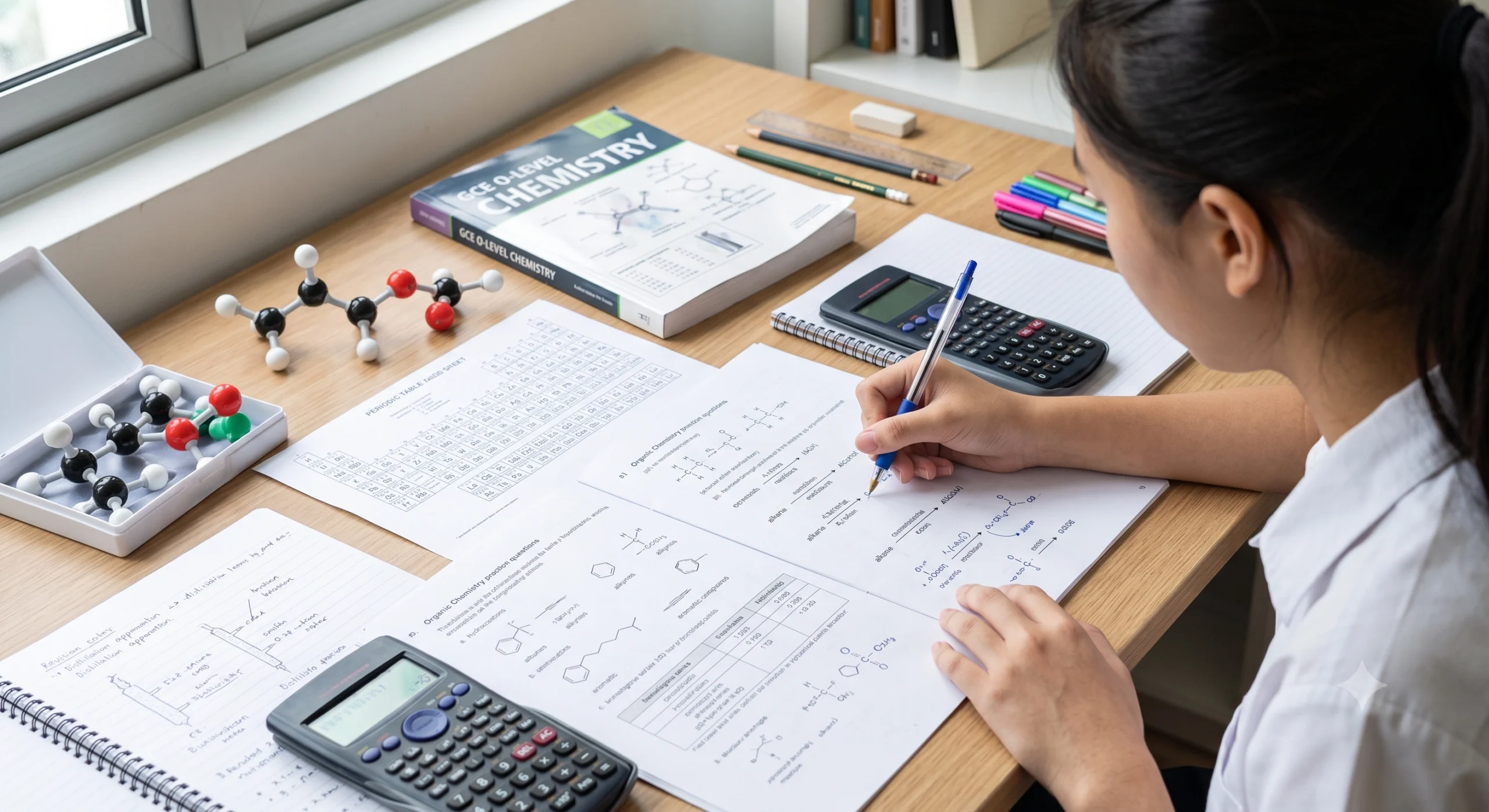
There is a specific moment many Sec 4 Chemistry students describe. They have revised the chapter thoroughly. They understand alkanes, alkenes, alcohols, carboxylic acids, and esters well enough to answer textbook questions correctly. Then they see an exam question they have not encountered before, and all of that knowledge fails to activate.
This is the Organic Chemistry problem in a nutshell. The gap between knowing the content and being able to apply it in unfamiliar exam scenarios is precisely where students lose the marks that separate B3 from A1. This guide explains where that gap comes from, how to close it, and what effective revision for Organic Chemistry actually looks like.
Why Organic Chemistry Is the Make-or-Break Chapter for A1
Organic Chemistry makes up a significant portion of the O-Level Chemistry Paper 2. It is tested through structured questions that require students to identify functional groups, predict products of reactions, write balanced equations, describe identification tests, and explain reaction mechanisms in words.
Each of these question types demands a different kind of thinking. Identifying a functional group from a molecular formula requires recognition. Predicting a product requires understanding how the reaction works. Writing a balanced equation requires care and procedural accuracy. Describing an identification test requires precise language. A student who is weak in any one of these areas will lose marks even if they are strong in the others.
The volume of content adds to the difficulty. There are five major homologous series to learn: alkanes, alkenes, alcohols, carboxylic acids, and esters. Each has its own properties, reactions, and tests. Students who try to memorise all of this as a list of facts quickly find the volume overwhelming.
If your child takes Chemistry as part of Combined Science, the same Organic Chemistry traps apply. Our combined chemistry and biology tuition covers them for the Chemistry/Biology pairing, and our secondary science tuition builds the foundations in Sec 1 and Sec 2.
Learning Reaction Patterns Instead of Memorising Individual Reactions
The most effective shift a student can make in approaching Organic Chemistry is to stop memorising reactions and start understanding patterns.
Consider alkenes. They undergo addition reactions because the carbon-carbon double bond is a site of high electron density that attracts electrophilic reagents. When you understand this, you can predict that bromine water (an electrophile) will decolorise in the presence of an alkene, that hydrogen will add across the double bond in hydrogenation, and that water will add in hydration to form an alcohol. These are not three separate facts to memorise. They are three applications of one underlying principle.
Similarly, esterification is not a random reaction between an acid and an alcohol. It is an equilibrium process in which the carboxylic acid group and the alcohol group react with the loss of water. Understanding this equilibrium explains why the yield is never 100 percent, why concentrated sulphuric acid is used as a catalyst, and why the reaction can be reversed through hydrolysis. One principle, many exam questions.
For students who want detailed revision notes structured around these patterns, our full breakdown of O-Level Organic Chemistry notes for Sec 4 students covers each homologous series systematically.
The Identification Tests You Must Know Cold
Identification tests are some of the most reliably tested content in Organic Chemistry. The examiner expects students to state the reagent, the observation, and the conclusion for each test. Missing any one of these three elements typically costs marks.
The test for an alkene uses bromine water: the observation is that the orange bromine water decolourises; the conclusion is that a carbon-carbon double bond is present. The test for an alcohol uses acidified potassium dichromate (VI): the observation is that the orange solution turns green (for a primary or secondary alcohol); the conclusion is that oxidation has occurred.
Students should practise writing these descriptions in full sentences, using the exact chemical language the examiner expects. A vague answer like ‘the colour changes’ is not equivalent to ‘the orange bromine water decolourises’ and will not earn the mark.
This precision in language is the same skill required throughout Paper 2, not just in Organic Chemistry. Understanding what the examiner considers a complete answer is a key component of what good O-Level Chemistry tuition in Singapore teaches.

How to Approach Organic Chemistry Exam Questions
When faced with a multi-step Organic Chemistry question in an exam, the first step is to identify the functional groups present in each molecule in the reaction sequence. Once you know what you are working with, you can apply the appropriate reaction rules.
For questions that ask you to convert one compound into another (a synthesis question), work backwards from the target molecule. Ask: what reaction produces this functional group? What starting material would that reaction require? This reverse-engineering approach is far more reliable than trying to move forward from the starting material through trial and error.
Check your answers by considering: does the product have the correct functional group? Is the equation balanced? Have you accounted for the conditions (catalyst, temperature, pressure) where required? Questions that ask for conditions are testing whether you understand the reaction mechanism, not just its outcome.
The Role of Past Papers in Building Exam Readiness
Past O-Level Chemistry papers are the most valuable revision resource available, not because they predict what will appear but because they reveal what kinds of questions the examination consistently tests. Organic Chemistry questions in past papers follow recognisable patterns in how they are structured, what they require students to explain, and where marks are typically placed.
Effective past paper practice means doing more than arriving at the correct final answer. It means comparing your answer against the mark scheme word for word, identifying where your phrasing was imprecise, and rewriting the answer until the language matches what the examiner expects.
Students who practise this way, rather than simply checking whether they got the right product, develop a sense of examiner expectation that significantly improves their marks on unfamiliar questions.
If you are looking for guidance on the difference between O-Level Pure Chemistry vs Combined Science, the articles with title: O-Level Pure Chemistry vs Combined Science Chemistry: Key Differences Explained can help you get a better understanding.
When Organic Chemistry Needs Extra Support
There is a point in every revision cycle where self-study reaches its limits. For Organic Chemistry, that point usually arrives when a student can answer textbook questions correctly but still cannot reliably handle exam-format questions. This is the gap that tuition is best positioned to address.
A tutor working through Organic Chemistry with a student will ask questions that a textbook cannot: What is the functional group here? Why does this reaction happen? What would you expect if the question changed this condition? These probing questions reveal exactly where the student’s understanding is surface-level rather than deep.
Ready to get started? Explore our O-Level Chemistry Tuition programme
Frequently Asked Questions
Which homologous series causes the most problems for O-Level Chemistry students?
Alcohols and carboxylic acids are the most consistently challenging because they are involved in multiple reaction types (oxidation, esterification, dehydration for alcohols) that students frequently confuse. Practising each reaction type separately before combining them is the most effective approach.
How important is it to know structural formulas for Organic Chemistry?
Very important. Examination questions regularly require students to draw structural formulas for organic compounds. Students who can only write molecular formulas without understanding the structural arrangement will miss marks on these questions.
What is the most common mistake in Organic Chemistry exam answers?
Incomplete identification test answers. Students frequently state either the observation or the conclusion but not both, and miss the reagent description. All three elements are required for full marks.
Does revision order matter for Organic Chemistry?
Yes. Revise alkanes first, then alkenes, then alcohols, then carboxylic acids, then esters. This order follows the logical progression of increasing functionality and makes the connections between reaction types easier to see. Jumping around makes the content harder to retain.
How much of the O-Level Chemistry paper is Organic Chemistry?
Organic Chemistry typically accounts for around 20 to 30 percent of Paper 2 marks, making it one of the highest-weightage individual topics. It also appears in Paper 1 MCQ. Students who master it have a significant structural advantage.
Scoring A1 in O-Level Chemistry through Organic Chemistry is achievable for most students who are willing to change how they revise. The shift is from memorisation to understanding patterns, and from practising questions to practising answers. Once that shift happens, the content that felt overwhelming becomes manageable.