

 Available 24/7
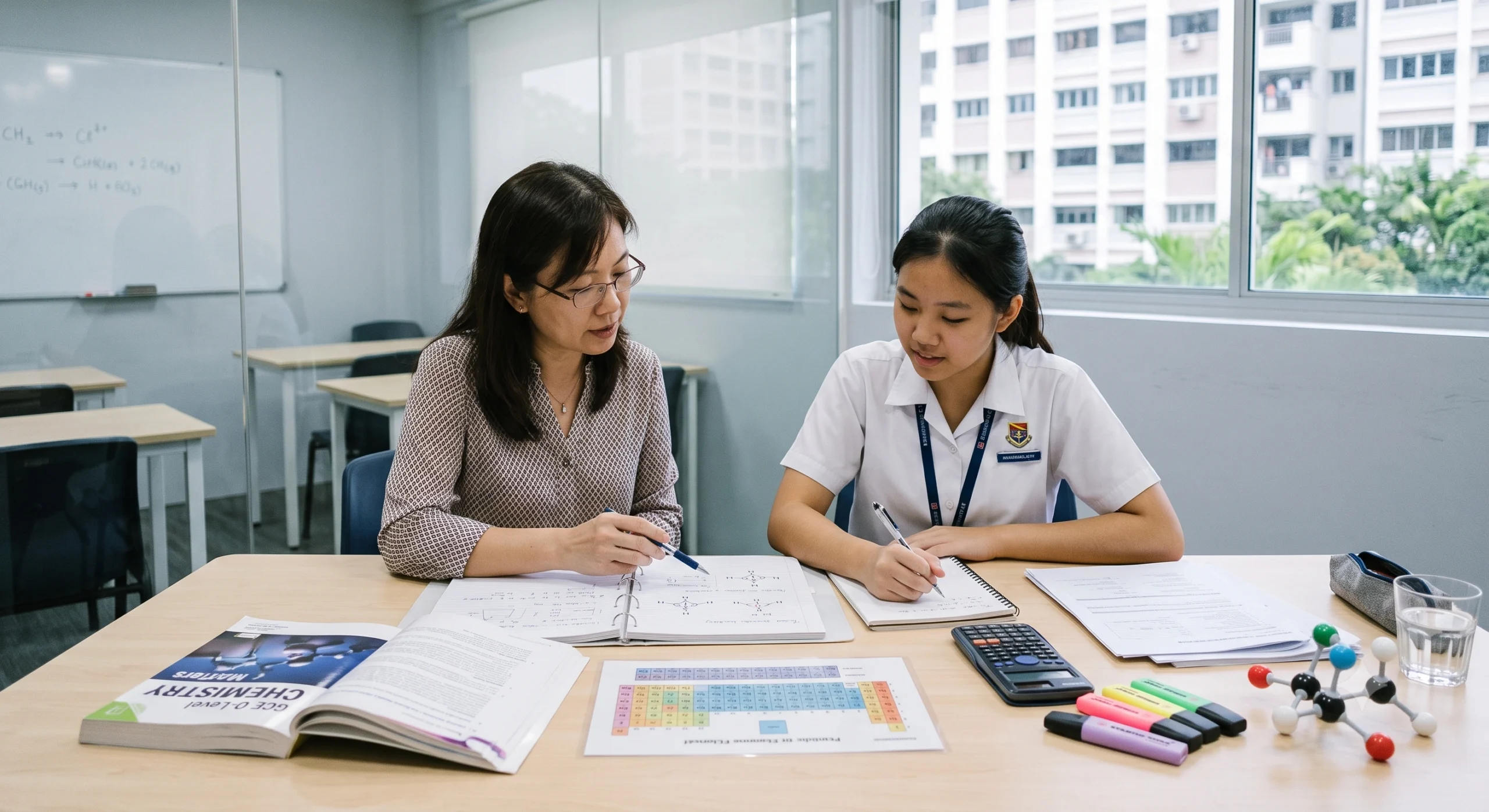
The five O-Level Chemistry topics that trip students up most are the Mole Concept, Organic Chemistry, Electrolysis and Redox, Chemical Bonding, and Acids, Bases and Salt Preparation. They share one trait: each rewards genuine understanding over memorisation, which is why they cost marks even for students who revise diligently.
| Topic | Why it trips students up | What it really needs |
|---|---|---|
| Mole Concept | Underpins every quantitative question; a shaky grasp bleeds marks across chapters. | Fluent conversion between mass, moles and concentration |
| Organic Chemistry | Many homologous series, reactions and tests; memorising without logic fails. | Learning reaction patterns, not lists |
| Electrolysis & Redox | Abstract, invisible electron movement; rules interact in tricky ways. | Systematic half-equation and discharge reasoning |
| Chemical Bonding | Knowing bond types is not the same as explaining properties from them. | Linking bonding and structure to properties |
| Acids, Bases & Salt Preparation | Combines concepts with laboratory procedure and solubility rules. | Correct method selection from solubility |
Reviewed by Tutor Glen, O-Level Chemistry tutor at Arche Academy.
A parent calls the school at the end of Term 2. Her daughter’s Chemistry grade has dropped from a B3 to a D7 in a single semester. The parent is confused because her daughter attends every lesson, completes her homework, and genuinely seems to understand things when she reviews her notes at home. What happened?
This is one of the most common Chemistry questions parents in Singapore ask. The answer, almost always, lies in one of five specific topics that demand a depth of understanding that surface-level revision cannot provide. Knowing which topics these are, and why they cause so many problems, is the first step toward addressing them effectively.
What the O-Level Chemistry Exam Actually Tests
O-Level Chemistry in Singapore covers a broad syllabus, but the examination is not primarily a test of content recall. It is a test of chemical reasoning: the ability to explain why a reaction happens, predict what will happen under different conditions, and perform calculations with a clear understanding of what the numbers represent.
Papers 1 (MCQ) and Paper 2 (structured questions) together test these skills under time pressure. Paper 2 in particular rewards students who can construct logical, precise explanations using correct chemical terminology. A student who understands a concept but expresses it vaguely will lose marks even when their underlying knowledge is correct.
This distinction, between understanding and being able to demonstrate understanding in the exact form the examiner expects, is what separates B3 students from A1 students in Chemistry.
Taking Chemistry within Combined Science rather than as a pure subject? These topics appear in the Combined Science Chemistry paper too. Our O-Level Combined Science tuition runs dedicated Chemistry/Biology and Physics/Chemistry classes, capped at five students.
Topic 1: The Mole Concept
The Mole Concept is the foundation of nearly every quantitative Chemistry question. Stoichiometry, concentration calculations, titration, and yield questions all require students to work fluently with moles. Students who have an unstable understanding of this topic consistently bleed marks across multiple chapters, often without identifying the root cause.
The difficulty is partly conceptual and partly computational. Students need to understand that a mole is simply a counting unit for particles, that molar mass links mass to moles, and that ratios in chemical equations tell you the mole ratios of reactants and products. When any of these ideas is shaky, the calculation chain breaks down.
The practical consequence: a student who cannot reliably convert between mass, moles, and concentration will struggle not just with the Mole Concept chapter but with every quantitative question that appears later in the paper.
Topic 2: Organic Chemistry
Organic Chemistry is the topic most responsible for students missing the A1 threshold. It involves multiple homologous series, each with its own reactions, functional group tests, and naming conventions. Students who try to memorise every reaction without understanding the underlying logic run out of capacity and make systematic errors under exam pressure.
The more effective approach is to learn reaction patterns: alcohols can be oxidised, dehydrated, or reacted with carboxylic acids; alkenes undergo addition reactions across the double bond; esters are formed from acids and alcohols with the release of water. When a student understands why these reactions happen, unfamiliar exam questions become manageable rather than baffling.
Identification tests are another high-stakes area. Students must be able to describe tests for functional groups correctly, including the reagent, the observation, and the conclusion. Incomplete answers, such as stating the observation without the conclusion, regularly cost marks.
For a detailed breakdown of Organic Chemistry revision strategies, see the article on how to score A1 in O-Level Chemistry through Organic Chemistry mastery.
Topic 3: Electrolysis and Redox Reactions
Electrolysis and Redox are conceptually abstract topics that confuse students for a similar reason: they both involve electrons moving in ways that are not visible or physically intuitive.
In Electrolysis, students must determine what is discharged at each electrode based on the concentration of the solution, the type of electrode, and the position of ions in the electrochemical series. The rules themselves are learnable, but they interact with each other in ways that require clear, systematic thinking.
Redox reactions require students to track oxidation states, write half-equations, and combine them correctly. Students who rely on shortcuts without understanding the electron transfer model consistently make errors when questions present novel scenarios.
A common error: confusing oxidation and reduction. Oxidation involves the loss of electrons; reduction involves their gain. Remembering OIL RIG (Oxidation Is Loss, Reduction Is Gain) is a start, but applying it correctly to half-equation writing is what the exam tests.
Topic 4: Chemical Bonding
Chemical Bonding is a topic where students often feel they understand the material in class but cannot apply it in questions. This is because understanding the types of bonding (ionic, covalent, metallic) is not the same as being able to use bonding to explain physical properties.
The examination regularly asks students to explain melting point, conductivity, or solubility in terms of the bonding and structure of a substance. A student who knows that sodium chloride is an ionic compound but cannot explain why it conducts electricity when dissolved (but not when solid) has a conceptual gap that will cost marks.
Building genuine understanding here means working through the implications of each bonding type systematically, rather than memorising lists of properties without connecting them to the underlying chemistry.
Topic 5: Acids, Bases and Salt Preparation
Acids, Bases and Salt Preparation is a topic that tests both conceptual understanding and procedural knowledge. Students need to know the properties of acids and bases, the neutralisation process, and the correct laboratory procedures for preparing different types of salts.
Salt preparation questions in particular require students to select the appropriate method (direct combination, precipitation, titration) based on the solubility of the salt and the reactivity of its components. Students who do not know the solubility rules reliably make errors in method selection.
A further complication: questions about acids and bases often require students to explain changes in pH or to interpret indicator results in terms of the ionic concentration. Students who understand only the qualitative rules without the underlying equilibrium concepts struggle with these extensions.
How Structured O-Level Chemistry Tuition Addresses These Gaps
The five topics above share a common thread: they all require understanding over memorisation. This is also why they are the most difficult to self-study. A student reading a textbook can follow the logic of a worked example without detecting their own misunderstanding. It takes a teacher asking the right question to reveal where the thinking breaks down.
Structured Chemistry tuition at Arche Academy, in a small-group setting, creates the conditions for this kind of diagnosis and correction. A tutor watching a student work through a Mole Concept calculation can identify whether the error is in the conceptual understanding or the algebraic manipulation, and address each differently.
For students who are also studying Physics as part of a combined programme, it is worth understanding how the two subjects interact. Our overview of how to choose combined science tuition in Singapore gives a practical framework for parents making programme decisions.
Ready to get started? Learn more about our O-Level Chemistry Tuition programme
If one of these five is costing marks
Our Pure Chemistry and Combined Science classes take five students at most, so the topic that is losing marks gets found and worked on.
O-Level Chemistry tuition · Combined Science tuition · Book a trial lesson →
Frequently Asked Questions
What are the hardest topics in O-Level Chemistry?
The five topics that most often cost marks are the Mole Concept, Organic Chemistry, Electrolysis and Redox, Chemical Bonding, and Acids, Bases and Salt Preparation. They are difficult not because they are inaccessible, but because each rewards understanding and precise explanation over memorisation.
Which O-Level Chemistry topic should my child prioritise first?
Start with the Mole Concept. It is the foundation that supports the most number of subsequent topics. A student who cannot work fluently with moles will consistently lose marks across multiple sections of the paper.
Is O-Level Chemistry harder than O-Level Physics?
They are difficult in different ways. Chemistry demands more content coverage and precise written expression. Physics demands more mathematical application and conceptual reasoning about forces and energy. Most students find whichever subject they have a weaker foundation in to be more challenging.
How many months before the O-Level exam should my child start intensive revision?
Serious revision should begin at the start of Sec 4, not just in the months before the exam. Students who treat Sec 4 as the revision year and Sec 3 as the learning year consistently find they have too many gaps to address in the time available.
Can my child recover a failing Chemistry grade in Sec 4?
Yes, but it requires identifying exactly which Sec 3 concepts are insecure and addressing them systematically before layering Sec 4 content on top. This is where a diagnostic approach in tuition, rather than just practising more questions, makes the critical difference.
Does O-Level Chemistry require practical skills?
Yes. Paper 3 is a practical examination. Students need to be able to plan experiments, conduct titrations, and record observations accurately. These skills cannot be crammed and benefit significantly from guided practice in a structured programme.
O-Level Chemistry rewards students who engage with the subject rather than memorise it. The five topics above are difficult not because they are inherently inaccessible, but because they require a quality of understanding that most students do not build through classroom lessons alone.
Want to find out exactly where your child’s Chemistry gaps are?