

 Available 24/7
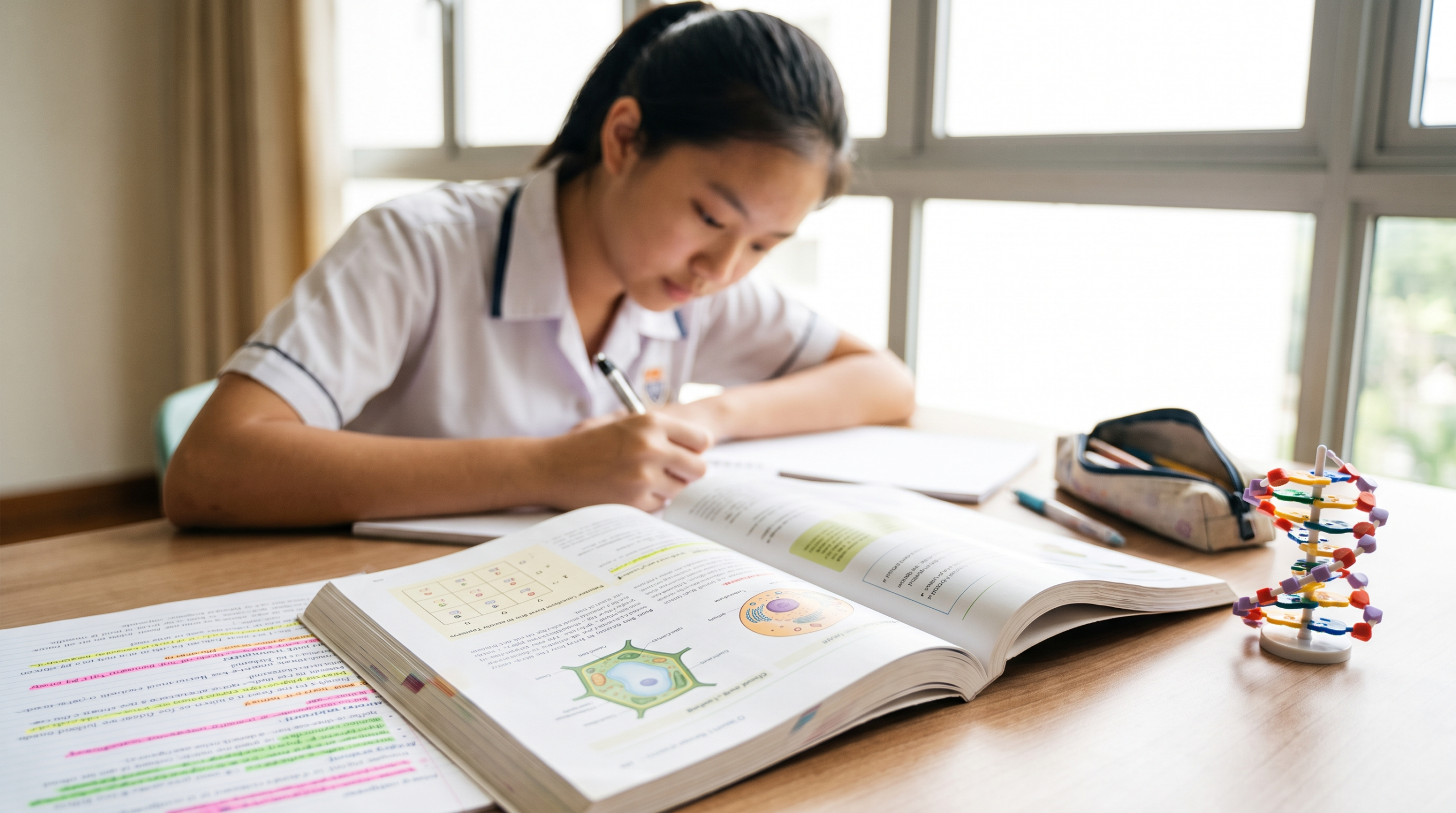
A Secondary 3 student walks into her first Biology lesson convinced the subject will be her strongest. She has always found science interesting, enjoys reading about living things, and figures that Biology will be more about understanding than calculation. Six months later, she is staring at a Genetics question involving multiple alleles and incomplete dominance, wondering how a subject she thought she would love became this difficult.
The experience is common. O-Level Biology has a reputation as the most approachable of the three sciences, and in some areas that reputation is deserved. But it also contains topics that require genuine conceptual depth, precise written expression, and the ability to apply knowledge to unfamiliar experimental scenarios. Knowing which is which, before your child encounters the harder topics, makes a meaningful difference in how they prepare.
How the O-Level Biology Syllabus Is Structured
O-Level Biology (syllabus 6093) is divided into several major themes: Cell Biology, Biological Molecules, Movement of Substances, Nutrition, Transport, Respiration, Excretion, Coordination and Response, Reproduction, Molecular Genetics, and Ecology.
The examination tests these areas across three papers: Paper 1 (MCQ), Paper 2 (structured and free-response questions), and Paper 3 (the practical examination). Paper 2 in particular requires students to write extended answers, describe experimental procedures, analyse data, and explain biological processes using correct terminology.
The breadth of the syllabus is one of its defining features. Biology covers more distinct topic areas than either Physics or Chemistry. A student who is strong in some areas but weak in others cannot easily compensate through depth in their strong topics, because each topic carries dedicated marks in the examination. It is why our O-Level Biology tuition works through every theme in the order your child’s school teaches it, in classes of five.
For students weighing the combined-science route, our guide to O-Level Combined Science covers how the Biology component fits into a broader science programme.
On the Chemistry/Biology Combined Science pairing, many of these topics show up in the Biology paper as well. Our combined chemistry and biology tuition teaches both sciences every week, and our secondary science tuition covers the Sec 1 and Sec 2 groundwork.
The More Manageable Topics in O-Level Biology
Nutrition is consistently one of the more accessible topics for students who engage with it methodically. The content covers the digestive system, nutrient types, and their functions in the body. The facts are concrete and the questions tend to be more straightforward in structure. Students who learn the digestive system diagram accurately and understand the roles of enzymes in digestion can score reliably in this section.
Cell Biology and Cell Division introduce microscopy, cell structure, and the processes of mitosis and meiosis. These topics reward consistent memorisation of a specific set of organelles and their functions. The diagram-based questions here are predictable in form, though the precision of labelling matters.
Reproduction is another area students generally find more straightforward than they expect. Sexual and asexual reproduction, the structure of the reproductive system, and the processes of fertilisation and development follow clear logical sequences, and the exam questions tend to follow established formats.
Ecology introduces food chains, food webs, energy flow, and the impact of human activity on ecosystems. Students who engage with this topic conceptually rather than just memorising definitions tend to find it accessible. The free-response questions in this section often test whether students can apply principles to unfamiliar scenarios, which rewards genuine understanding over rote learning.
The Hardest Topics in O-Level Biology, Ranked
Genetics sits consistently at the top of the difficulty ranking. The topic requires students to understand the relationship between genes and alleles, apply probability to predicting offspring ratios, and work through cross diagrams involving dominant, recessive, and codominant traits. What makes it particularly difficult is that it combines abstract concepts with procedural problem-solving in a single question: students need to understand what a genotype and phenotype represent, then apply that understanding to draw a genetic cross correctly, then interpret the results accurately. Students who memorise the procedure without understanding the concepts make systematic errors when questions are presented in unfamiliar ways.
Transport in Plants is another consistently challenging topic. The structure and function of xylem and phloem, the mechanisms of transpiration, and the processes of osmosis and active transport require students to build a mental model of how water and solutes move through a plant. Because these processes cannot be directly observed, they are difficult to internalise through reading alone.
Respiration is often underestimated by students who assume it is simply about breathing. O-Level Biology requires understanding cellular respiration at a biochemical level: the stages of glycolysis and aerobic respiration, the role of ATP, the difference between aerobic and anaerobic respiration, and how the respiratory quotient (RQ) is used to determine the substrate being respired. The mathematical element surprises students who expect Biology to be purely descriptive.
Coordination and Response — covering the nervous system, endocrine system, and the mechanics of reflex arcs and feedback mechanisms — requires students to distinguish between multiple interacting systems and explain how they work together. Questions here often require tracing the pathway of a response through multiple steps, using precise terminology at each stage.
Molecular Genetics, at the upper end of the syllabus, covers DNA structure, replication, transcription, and translation. This is where students who have struggled with abstract thinking throughout the course tend to find their difficulties compounding. The molecular level demands a genuinely different way of thinking about biology compared to the organ-level content of earlier chapters.
Why Biology Exam Technique Matters as Much as Content Knowledge
One of the most underappreciated aspects of O-Level Biology is how much the examination rewards precise language. Unlike Physics, where a mathematical answer is either correct or incorrect, Biology free-response questions award marks for the specific vocabulary and logical structure of a written explanation.
A student explaining osmosis who writes “water moves from where there is more water to where there is less” will not receive full marks. The expected answer references water potential: water moves by osmosis from a region of higher water potential to a region of lower water potential across a partially permeable membrane. The concept is the same. The language is entirely different. And the marks are awarded for the language.
This is a skill that requires deliberate practice. Students who review mark schemes after completing past papers, and specifically compare their phrasing against the expected answer, develop examiner literacy over time. Students who simply check whether they got the concept right in principle do not build this skill. Our overview of science tuition at Arche Academy explains how our programmes address both content and exam technique.
How Biology Tuition Helps Students Bridge the Content-Exam Gap
Biology tuition is most effective when it addresses two things at once: the conceptual gaps that prevent students from understanding the material, and the exam-technique gaps that prevent them from expressing what they do understand.
For a topic like Genetics, effective tuition involves working through genetic crosses until the student understands the logic of each step, not just the procedure — asking the student to explain what a genotype represents before asking them to write a cross diagram. This diagnostic approach surfaces the misunderstandings that prevent improvement. For exam technique, it involves practising with actual past papers under timed conditions and then reviewing the mark scheme in detail, identifying the specific phrases the examiner accepted and practising incorporating those phrases into later answers.
Small-group classes are particularly effective for Biology because a student who hears a tutor explain a concept and then attempts to explain it themselves quickly discovers which parts of their understanding are secure. It is a learning dynamic that independent study and large tutorial classes cannot replicate — you can read what families say about it on our testimonials page.
Ready to get started? Explore our O-Level Biology Tuition programme
Frequently Asked Questions
Is O-Level Biology harder than Chemistry?
They are difficult in different ways. Biology covers more topic-area breadth and rewards precise written expression. Chemistry has a heavier quantitative component and requires chemical reasoning about reactions and bonding. Most students find whichever subject they have weaker foundations in to be the more challenging one.
How should my child approach revision for Genetics?
Start with the conceptual definitions: what is a gene, what is an allele, what is a genotype, and what is a phenotype. Only once these are genuinely understood should the student attempt genetic cross diagrams. Students who jump straight to crosses without securing the concepts repeat the same procedural errors without understanding why.
Why does my child understand Biology in class but struggle in exams?
This is almost always a language-precision issue. Understanding a concept and expressing it with examiner-expected vocabulary are two different skills. The solution is consistent practice with past papers followed by detailed mark-scheme review, with specific attention to the phrasing the examiner uses.
Which Biology topic should my child revise first for O-Levels?
Genetics, because it is the most consistently challenging topic and the most mark-intensive in Paper 2. Securing Genetics early in the revision cycle gives the highest return on time invested. Transport, Respiration, and Coordination and Response should follow.
Does O-Level Biology practical training require special preparation?
Yes. Paper 3 tests students on planning experiments, recording observations systematically, interpreting data, and evaluating experimental design. These are not skills that emerge from content revision alone; students benefit from guided practical training that walks through the kinds of scenarios that appear in the practical paper.
O-Level Biology is a subject where preparation strategy matters more than raw aptitude. Students who identify the harder topics early, develop genuine understanding rather than surface memorisation, and practise with past papers under timed conditions consistently outperform students who study harder without studying smarter.
If you want your child to start their Biology preparation on the right footing, book a trial class and let our tutors show them what structured Biology preparation looks like.