

 Available 24/7
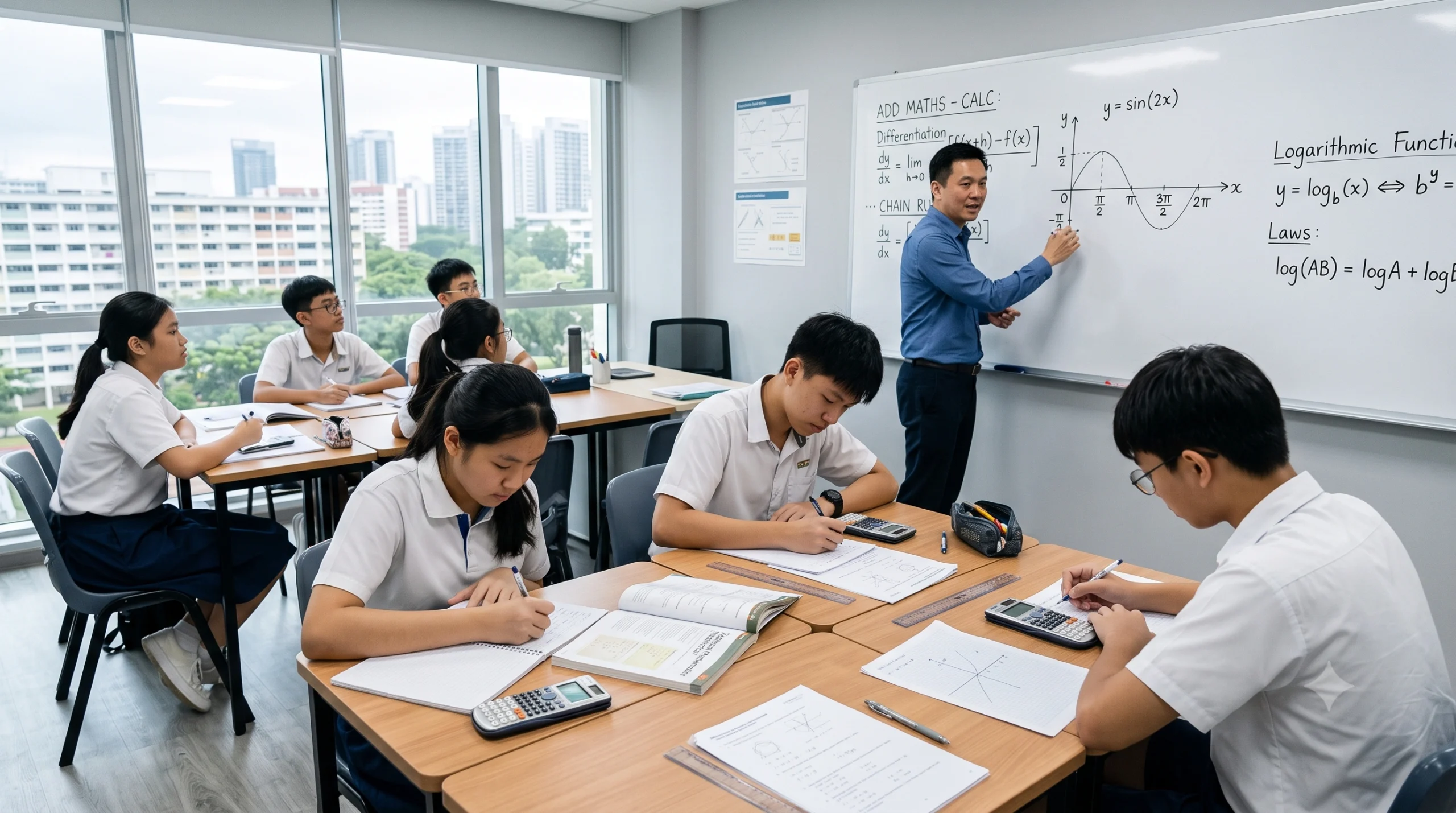
Sec 3 is make-or-break for O-Level Additional Mathematics (A-Maths) because the subject introduces entirely new domains — radian trigonometry, differentiation, integration, logarithms and proofs — that have no equivalent in lower-secondary maths, taught at a pace schools cannot slow down for individuals. A-Maths is strictly cumulative, so a gap formed in Sec 3 compounds through Sec 4. The students who do well are usually the ones who get targeted support early, in Term 1, before those gaps widen.
Reviewed by Tutor Glen, O-Level Maths tutor at Arche Academy.
Here is a pattern that plays out in schools across Singapore every year. A student finishes Sec 2 with decent grades, feels relatively confident about Mathematics, and walks into Sec 3 Additional Maths expecting more of the same. By the end of Term 1, the confidence is gone. The content is nothing like lower secondary Maths, the pace feels relentless, and the student is already three chapters behind with no clear sense of how to catch up.
This is not a story about a child who is bad at Maths. It is a story about a syllabus that demands a fundamentally different kind of thinking, introduced at a pace that most schools cannot slow down for individual students. Understanding what Sec 3 A-Maths actually requires, and why it matters so much for O-Level outcomes, is the starting point for every parent whose child is about to enter this year.
What Makes A-Maths a Different Subject Altogether
O-Level Additional Mathematics (syllabus 4049) sits in a different category from Elementary Mathematics. E-Maths, while not easy, builds on familiar arithmetic and algebraic ideas. A-Maths introduces entirely new domains: trigonometry with radian measure, differentiation, integration, logarithms, and proofs. None of these have direct equivalents in lower secondary content.
The jump is not incremental. It is categorical. Students who approach A-Maths expecting to extend their Sec 2 skills quickly discover that the subject requires a new mode of reasoning: working backwards from what you want to prove, applying transformations to functions, and managing multi-step problems where an error in step two invalidates everything that follows.
For students thinking ahead to the A-Level pathway, A-Maths also matters practically. H2 Mathematics at JC relies heavily on A-Maths foundations. Students who enter JC without a firm grasp of differentiation and integration face a significantly steeper adjustment period.
The Sec 3 Topics That Define Your Child’s O-Level Trajectory
The first semester of Sec 3 covers topics that are simultaneously foundational and unfamiliar. These are the chapters that students either consolidate well in Sec 3 or spend the rest of Sec 4 trying to patch over.
Indices and Surds introduces the manipulation of irrational numbers in algebraic form. Students who are not comfortable working with expressions like root 3 or 2 to the power of negative 3 find the subsequent topics much harder because these forms appear constantly throughout the rest of the syllabus.
Polynomials and the Remainder Theorem require students to work with higher-degree expressions and apply theorems to find unknown coefficients. The reasoning involved is more abstract than anything students have encountered in E-Maths.
Trigonometry in A-Maths goes significantly beyond what students learned at lower secondary level. Radians are introduced, along with compound angle formulas, the R-formula, and trigonometric identities. This section alone is responsible for a large proportion of grade drops in Term 2 assessments.
Differentiation, introduced toward the end of Sec 3, is a concept students need time to internalise. The rules themselves are learnable, but the applications, including curve sketching, rates of change, and optimisation, require the kind of problem-solving fluency that comes from sustained practice, not from a single chapter revision.
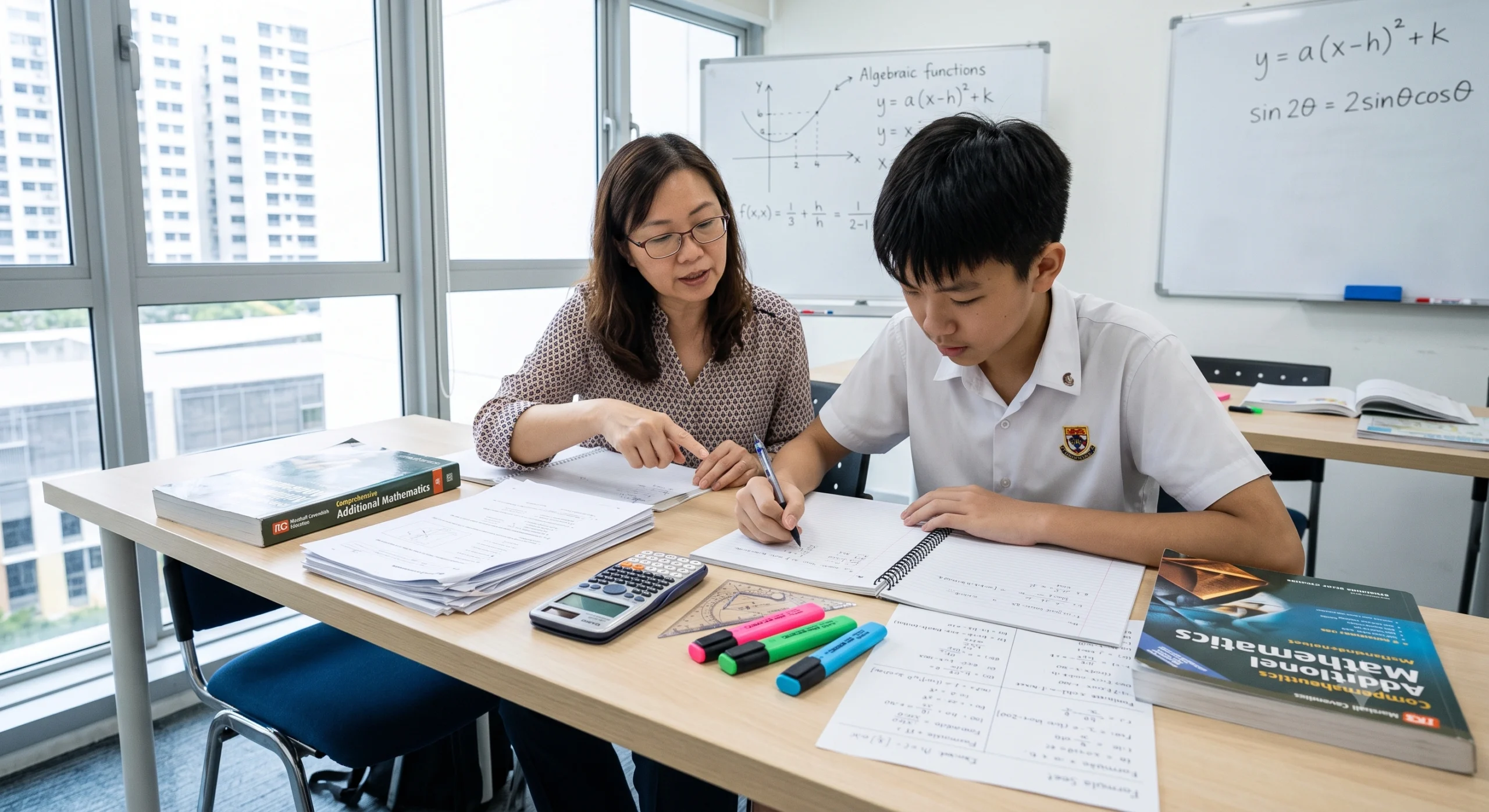
Why Students Who Fall Behind in Sec 3 Rarely Catch Up
A-Maths is a cumulative subject in the strictest sense. Polynomials feed into the Factor Theorem. The Factor Theorem feeds into solving cubic equations. Differentiation feeds into integration. A gap at any point creates compounding difficulty downstream.
What makes this particularly challenging is the pace of the school curriculum. Teachers are required to cover the full Sec 3 syllabus within the school year, which means they cannot slow down for students who need more time on a particular concept. A student who spends three weeks genuinely struggling with Trigonometry may find the class has moved to Differentiation before the first topic is secure.
This is the core reason why early intervention matters. A student who receives targeted A-Maths tuition in Term 1 of Sec 3, before gaps have time to widen, has a fundamentally different academic experience from one who seeks help in Sec 4 when the damage is already done.
For a broader look at how subject-level decisions affect academic trajectories, the article on subject-based banding and Mathematics progression in Singapore gives useful context.
A-Maths vs E-Maths: Should Your Child Take Both?
Many students in Singapore take both A-Maths and E-Maths as separate O-Level subjects. This is often the right call, but it requires honest assessment of the student’s aptitude and available study time.
E-Maths is compulsory for most streams and covers the foundational Mathematics that all students need. A-Maths is optional and is taken by students who are either comfortable with Mathematics and want to keep JC H2 Maths pathways open, or students whose target secondary school or tertiary programme requires it.
Taking both subjects adds to a student’s workload, which is manageable if the student is reasonably confident in Mathematics from the outset. For students who are already finding E-Maths challenging, adding A-Maths without additional support is a risk worth thinking through carefully.
The decision ideally happens before Sec 3 begins. Once a student is in the curriculum, dropping A-Maths mid-year is disruptive to timetabling and to the student’s confidence.
What Good A-Maths Tuition Actually Looks Like
The difference between A-Maths tuition that works and A-Maths tuition that does not is not about the number of practice papers handed out. It is about how gaps are identified and addressed.
Effective A-Maths tuition starts with diagnosing exactly which concepts the student has not internalised, not which topics they have covered in school. A student who has sat through the Trigonometry chapter may still have fundamental misconceptions about how to apply the compound angle formula. The tutor’s job is to find those misconceptions and address them directly, not to reteach the chapter from scratch.
Small group classes, where a tutor can observe a student’s working method and interrupt at the point of error, are far more effective for A-Maths than large tutorial classes where students passively copy solutions.
If your child is preparing for O-Level Maths, whether E-Maths, A-Maths, or both, take a look at how Arche Academy structures its programme.
Ready to get started? Explore our O-Level A-Maths Tuition classes
Frequently Asked Questions
Should my child start A-Maths tuition at the beginning of Sec 3 or wait to see how the first assessment goes?
Starting at the beginning of Sec 3 is significantly better. The first major assessment typically comes at the end of Term 1, by which point three or four chapters have already been covered. Waiting for the assessment result means reacting to a gap that has already formed rather than preventing it.
My child got A1 in E-Maths in Sec 2. Does that mean A-Maths will be manageable?
A strong E-Maths result is a positive indicator but not a guarantee. A-Maths introduces genuinely new domains that do not directly extend lower secondary Maths. Many students who excelled at E-Maths still find the A-Maths transition challenging without structured support.
Which A-Maths topic is most important to get right in Sec 3?
Trigonometry is the most consequential. It is heavily tested throughout Sec 4, and students who do not have a secure foundation in Sec 3 Trigonometry consistently struggle with the more complex forms of it that appear in the O-Level examination.
Is A-Maths necessary for JC?
A-Maths is not required to enter JC, but it is effectively required for students who want to take H2 Mathematics at A-Level. Most JC Maths teachers assume students have A-Maths foundations, and students without it face a steep disadvantage from JC1 Week 1.
Can a student who failed A-Maths in Sec 3 still score well at O-Level?
Yes, but it requires sustained, targeted effort across Sec 4. The student needs to identify and fill Sec 3 concept gaps systematically, not just practise Sec 4 topics. This is where structured tuition makes the biggest difference.
Sec 3 A-Maths is one of those academic moments that looks manageable from the outside but is genuinely difficult to navigate without support. The students who come out of Sec 3 with a solid foundation are not necessarily the most naturally gifted. They are the ones who got the right kind of help at the right time.
If your child is in Sec 3 or about to enter it, a consultant session with our expertise is a practical way to assess where they stand and what support would make the biggest difference.