

 Available 24/7

The PSLE results come out, and for a moment, whether the outcome was exactly what you hoped for or not, there’s an odd stillness. The exam that has anchored your family’s routine for years is finally behind you. Your child can breathe again. You can breathe again.
And then, usually within a few hours or a day or two, the next wave of questions begins. What schools should we list? How does the S1 Posting process work? If we got into a DSA school, what does that mean for posting? What subjects will my child be taking in secondary school? How soon should we think about academic support for the next chapter?
These questions are urgent because the decisions that follow PSLE results have real consequences, not just for which school your child attends, but for the subjects they study, the academic stream they enter, and how well-prepared they are for the O-Level years ahead. This guide walks through the post-PSLE planning process step by step.
Understanding the Two Pathways Into Secondary School
Most students in Singapore enter secondary school through one of two routes: the Secondary 1 Posting exercise (S1 Posting), which places students based on their PSLE results, or Direct School Admission (DSA-Sec), which is a talent-based placement route that happens before PSLE results are released.
If your child applied for DSA-Sec and received a Confirmed Offer, they are already placed at their secondary school and do not participate in S1 Posting. DSA-Sec students are expected to honour their commitment, they cannot subsequently participate in school choice through S1 Posting, and transfers from DSA-Sec placements are not permitted in Secondary 1. If your child is in this category, the planning focus shifts immediately to subject choice and preparation for Sec 1 at their assigned school.
For the majority of P6 students, S1 Posting is the pathway. This process allows students to submit up to six school preferences, ranked in order. PSLE results, school preferences, and available school vacancies determine the final placement. Schools typically publish their previous year’s Cut-Off Points (COP) as a reference, but COPs fluctuate each year based on the cohort and available vacancies.
How to Approach the S1 School Choice Process
The S1 Posting window opens after PSLE results are released, typically in late November, and closes within about a week. This is a short window to make a decision that will shape the next four or five years of your child’s secondary schooling, which makes it important to have done some preliminary thinking before results day.
The most common approach parents take is listing schools in strict order of perceived prestige or COP ranking, which is understandable but not always optimal. A school’s academic performance statistics are only one factor among several that determine whether it’s the right environment for a particular child.
Consider also the school’s culture and co-curricular life. A student who is passionate about drama or robotics will have a meaningfully different secondary school experience if they attend a school with a strong CCA community in their area of interest. Consider logistics too, a school that requires forty-five minutes of commuting each way adds ninety minutes to a secondary school student’s already long day, every day for four years.
Consider also the academic support available at the school for students who might need it. Express stream schools with strong supplementary programmes can be excellent environments for students who are borderline Express. The question is not just whether your child can get into a school, but whether that school’s ecosystem supports the kind of learner your child is.
The practical advice: rank your top two or three choices by genuine preference, then include one or two schools that your child’s PSLE score comfortably qualifies for as a buffer. Avoid listing only reach schools with no realistic safety options.
Express, Normal Academic, and Normal Technical: What the Streams Actually Mean
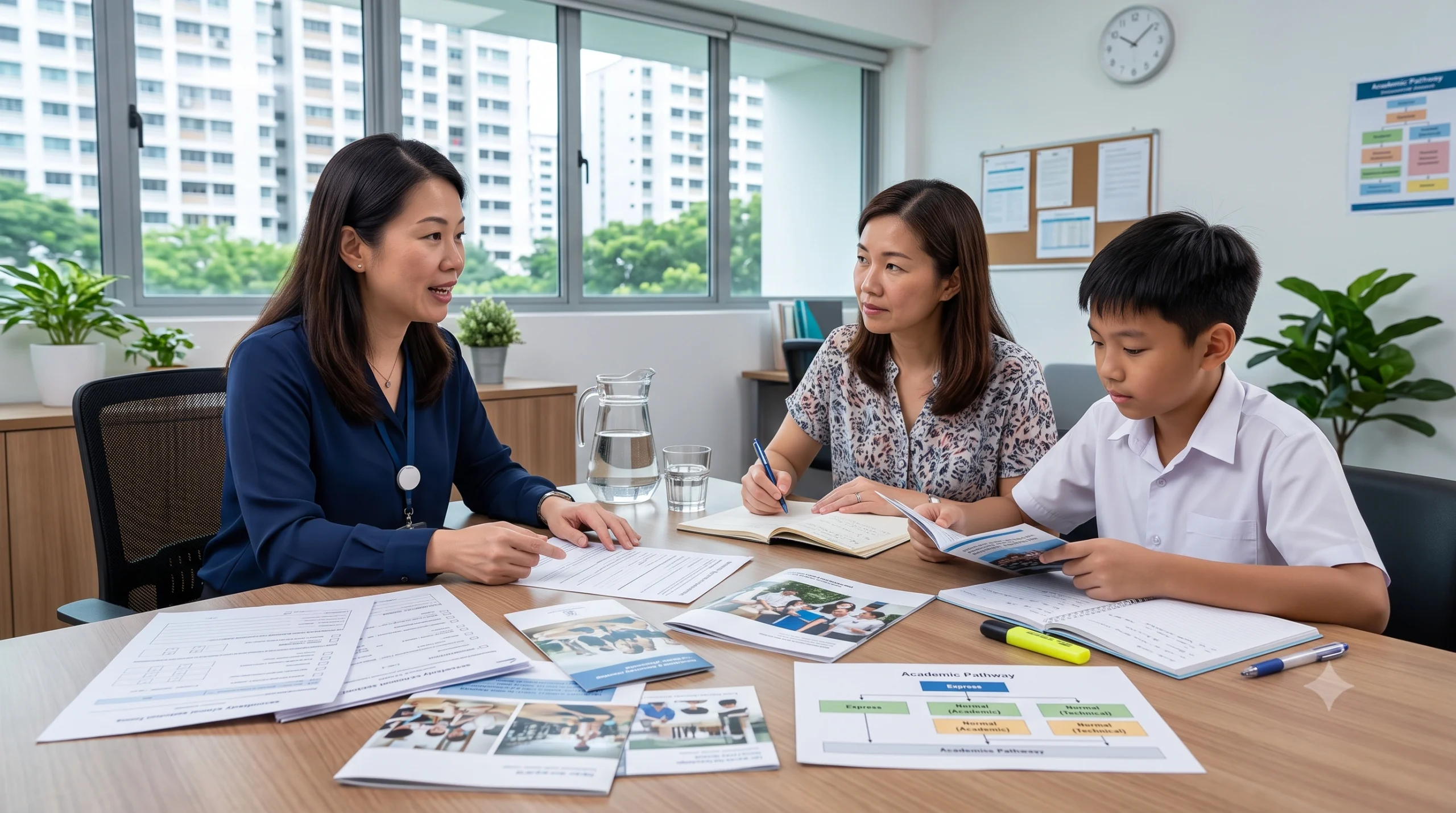
Secondary school in Singapore is currently structured across three academic streams: Express, Normal Academic (NA), and Normal Technical (NT). Understanding what these streams mean for your child’s educational trajectory is more important than many parents realise.
The Express stream leads to the O-Level examinations at the end of Sec 4. It covers a broader and more academically demanding curriculum and is the primary route toward Junior College or polytechnic after secondary school.
The Normal Academic stream leads to N-Level examinations at the end of Sec 4, with high-performing students having the option to progress to O-Level in Sec 5. There is also a Direct Polytechnic Programme (DPP) pathway for NA students who achieve strong N-Level results, allowing admission to polytechnic without completing Sec 5. The NA stream is not a lesser education, many students who enter secondary school in NA do extremely well in their N-Levels and access strong polytechnic programmes.
The Normal Technical stream focuses on technical and vocational subjects and leads to NT-Level examinations. Students in this stream often progress to the Institute of Technical Education (ITE), where vocational qualifications open pathways to polytechnic and beyond.
PSLE results determine the stream a student is placed in, though schools conduct their own assessments in some cases. Understanding which stream your child is entering, and what that means for the examinations ahead, should inform all subsequent planning decisions.
What Happens to Subjects in Secondary One
One of the most common misconceptions among P6 parents is that the subject combination decision happens immediately at the start of secondary school. In reality, Sec 1 involves a relatively fixed curriculum for all students. The major subject combination choices come later.
In Sec 1 and Sec 2, students study a core set of subjects including English Language, Mother Tongue Language, Mathematics, Science (typically an integrated science curriculum), Humanities, and often one or more electives. The specific subjects vary slightly by school, but the general structure is similar across the Express stream.
The important subject combination decisions happen at the end of Sec 2. At this point, students choose their subjects for Sec 3 and Sec 4, including the critical choice between Combined Science and Pure Science, whether to take Additional Mathematics alongside Elementary Mathematics, and which Humanities subjects to continue. These choices directly shape a student’s O-Level subject combination and, in turn, their post-secondary options.
For parents who are thinking ahead, understanding that the Sec 2 end-of-year period is when these decisions are made, and that those decisions have significant implications for university pathways, is worth knowing now. The P6 year may just be ending, but the next major decision point is only two years away.
Setting Up Academic Support Early in Secondary School
The transition from primary to secondary school is one of the more disorienting academic shifts a student experiences. The environment changes, the number of subjects increases, the depth of content increases, and the level of independent study expected of the student increases substantially.
Students who were strong in PSLE do not automatically find secondary school straightforward. The syllabus change is significant. Secondary school Mathematics, for instance, introduces algebraic concepts in Sec 1 that go considerably beyond what PSLE Maths required. Secondary school Science becomes increasingly conceptual and requires understanding mechanisms rather than recalling facts.
The Sec 1 year is an important period for establishing the study habits that will carry a student through O-Level. Students who build structured revision routines, engage with subject content beyond what the homework requires, and develop the habit of identifying and addressing their own knowledge gaps early tend to find the O-Level years considerably more manageable.
This is also the time to think honestly about which subjects your child is likely to find challenging in the secondary school environment. A student who found primary school Maths manageable but not easy may find secondary Maths more difficult. A student who was consistent in Science but never especially interested in it may find the increased conceptual demand of secondary Science less engaging. These patterns, identified early, can be addressed early.
If your child is heading into Sec 1 with an interest in eventually taking sciences at O-Level, starting to build foundational understanding in areas like algebraic thinking and scientific reasoning in the first year of secondary school, rather than waiting until Sec 3 when the difficulty jumps, is a significant advantage. The right Combined Science tuition or O-Level Maths support can provide that scaffolding at any point in the secondary journey.
The Transition Timeline: A Summary for Post-PSLE Families
For families navigating the period immediately after PSLE results, a practical timeline helps organise what needs to happen and when.
In the days immediately following results, the priority is processing the results and making a considered school choice for S1 Posting. This involves checking the COPs of preferred schools against your child’s PSLE score and ranking choices thoughtfully. Our secondary school cut-off points checker lets you enter the score and see which schools are in range for that score.
The S1 Posting exercise submission window opens within a week or two of results. Submit your ranked school preferences during this window.
School posting results are typically released in late December. Once your child’s secondary school is confirmed, the focus shifts to orientation and preparation for Sec 1.
In January, Sec 1 begins. The transition period is critical. Support your child in building consistent study habits, especially for Maths and Science, during the first semester.
At the end of Sec 2, the subject combination decision point arrives. This decision should be made with awareness of your child’s academic strengths, genuine interests, and post-secondary aspirations. Two years after that, those same choices set the aggregate behind JC and polytechnic admission.
Understanding this timeline now, even before the details feel immediately relevant, means you’re never navigating each stage with no context. The secondary school journey is long, but its broad shape is predictable from the outside, and planning ahead at each stage consistently produces better outcomes than reacting to each development as it arrives.
Frequently Asked Questions
How does DSA-Sec work if my child hasn’t received a Confirmed Offer yet?
DSA-Sec Confirmed Offers are typically announced in September, before PSLE. If your child received a Confirmed Offer, they are already placed at that school and do not participate in S1 Posting. If they received a Conditional Offer, acceptance depends on meeting certain PSLE criteria. Families in either situation should receive direct communication from the relevant school.
What if my child’s PSLE score is borderline between Express and Normal Academic?
Schools conduct their own assessments and may conduct interviews in some cases. If your child’s score places them at the borderline between streams, it is worth understanding the specific school’s approach. Some schools in the Express stream do support students who are at the lower range of the Express intake, the key question is whether the school’s academic culture and support systems are right for your child’s learning needs.
Is there any academic preparation that helps with Sec 1 specifically?
Building strong algebraic foundations in Mathematics and developing the habit of active reading in English (for secondary school comprehension and literature) are the two most widely beneficial areas of preparation. Secondary school introduces significantly more formal algebraic thinking than primary school, and students who enter Sec 1 with solid algebraic fluency tend to find the transition smoother.
When should I start thinking about secondary school tuition?
For most subjects, beginning in Sec 1 or Sec 2 and building good habits gradually is more effective than starting in Sec 3 or Sec 4 when the O-Level exam pressure is already high. The subjects that most commonly benefit from early Sec 3 support are Mathematics (particularly when A-Math is added to the combination) and the science subject your child has chosen. Identifying which subjects are likely to be challenging early gives the most options for addressing them.
Conclusion
The period after PSLE results can feel like a moment of rest after a long sprint, but it is also the beginning of the next chapter, and the decisions made in this period shape what that chapter looks like. The school choice, the stream, the subject combination two years ahead, and the academic habits established in Sec 1 all compound over time.
The most useful thing a parent can do in this period is stay informed, stay calm, and make decisions with a long-term lens rather than reacting to short-term anxieties. The secondary school journey is four to five years long. The students who thrive are usually those whose families approached it with realistic planning and consistent support, not necessarily those who attended the most prestigious school on their list.