

 Available 24/7

Every year, somewhere between the end of Sec 2 and the start of Sec 3, parents across Singapore sit through a school briefing on subject combinations. Teachers explain the options methodically. The slide deck is thorough. And yet most parents walk out of the hall with a version of the same question that walked in with them: should my child take Combined Science or Pure Science?
It’s not a trivial question. The choice made at this point shapes your child’s O-Level aggregate, their post-secondary pathway options, and the academic experience of their final two years of secondary school. Getting it wrong doesn’t necessarily close doors, but it does make some doors significantly harder to open.
This guide cuts through the jargon and explains what the two science tracks actually mean for your child, in terms of workload, grading, university pathways, and the student profile most likely to succeed in each.
What Combined Science and Pure Science Actually Mean
Combined Science covers two science disciplines, most commonly Physics and Chemistry, though Chemistry-Biology and Physics-Biology pairings are also offered, within a single O-Level subject. It counts as one subject in your child’s subject combination and produces one grade on the O-Level certificate.
Pure Science means taking each science as a standalone subject. A student who takes Pure Physics and Pure Chemistry has two separate O-Level entries, each graded independently.
The practical implication of this structural difference is significant and often misunderstood. Under the L1R5 system used to calculate secondary school aggregate scores for JC admission, a student who takes Pure Physics and Pure Chemistry can potentially use both grades in their aggregate. A student who takes Combined Science (Physics/Chemistry) has only one grade from that single subject available for inclusion. This difference can shift a student’s JC eligibility by several raw points before any other variable is considered.
This doesn’t make Combined Science the inferior choice, but it means the choice should be made with a clear understanding of this scoring mechanic, not based on an assumption that both tracks lead to the same outcomes.
The Depth and Workload Difference
A common belief among students is that Combined Science is simply an easier version of Pure Science. The reality is more nuanced.
Combined Science covers two sciences within roughly the same exam time that Pure Science dedicates to one. This means the content per subject is condensed, but the student is still managing two distinct knowledge domains. Students who find this “easier” typically do so because they find the reduced depth per topic less demanding. Students who find it harder than expected often discover that juggling two sciences, even at reduced depth, creates more cognitive load than they anticipated.
Pure Science goes considerably deeper in each subject. A student taking Pure Chemistry will encounter topics like organic chemistry in far more detail than a student taking Combined Science. A student taking Pure Physics will study topics such as radioactivity and nuclear physics at a level of depth not required in Combined Science. This depth is both the advantage and the challenge: it rewards strong scientific reasoning, but it also demands sustained effort over a longer syllabus.
One of the most common scenarios tutors encounter is a student who takes Pure Science in Sec 3, realises the workload is more than they anticipated, and either struggles through or transfers to Combined Science, a process that is administratively complicated and academically disruptive. The question of which track suits your child is better resolved before Sec 3 begins.
How Grading Works in Each Track
In Combined Science, both science disciplines are assessed together as a single subject, and the final grade reflects combined performance across both. A student who scores well in the Chemistry component but poorly in Physics will find their single Combined Science grade sitting somewhere between the two, not rewarding their Chemistry strength in the way a standalone Pure Chemistry grade would.
In Pure Science, each subject is graded independently. A student who excels in Chemistry but finds Physics difficult will have one strong grade and one weaker grade, rather than both being averaged into a single outcome. Depending on their L1R5 calculation, the stronger grade can be selected while the weaker one is less prominently featured.
For students who have a clear strength in one science and a clear weakness in another, Pure Science offers the flexibility to have that strength recognised on its own terms. For students who are consistently solid across both sciences but not exceptional in either, Combined Science can produce a stable A2 or B3 without the risk of two independent grades pulling the aggregate in different directions.
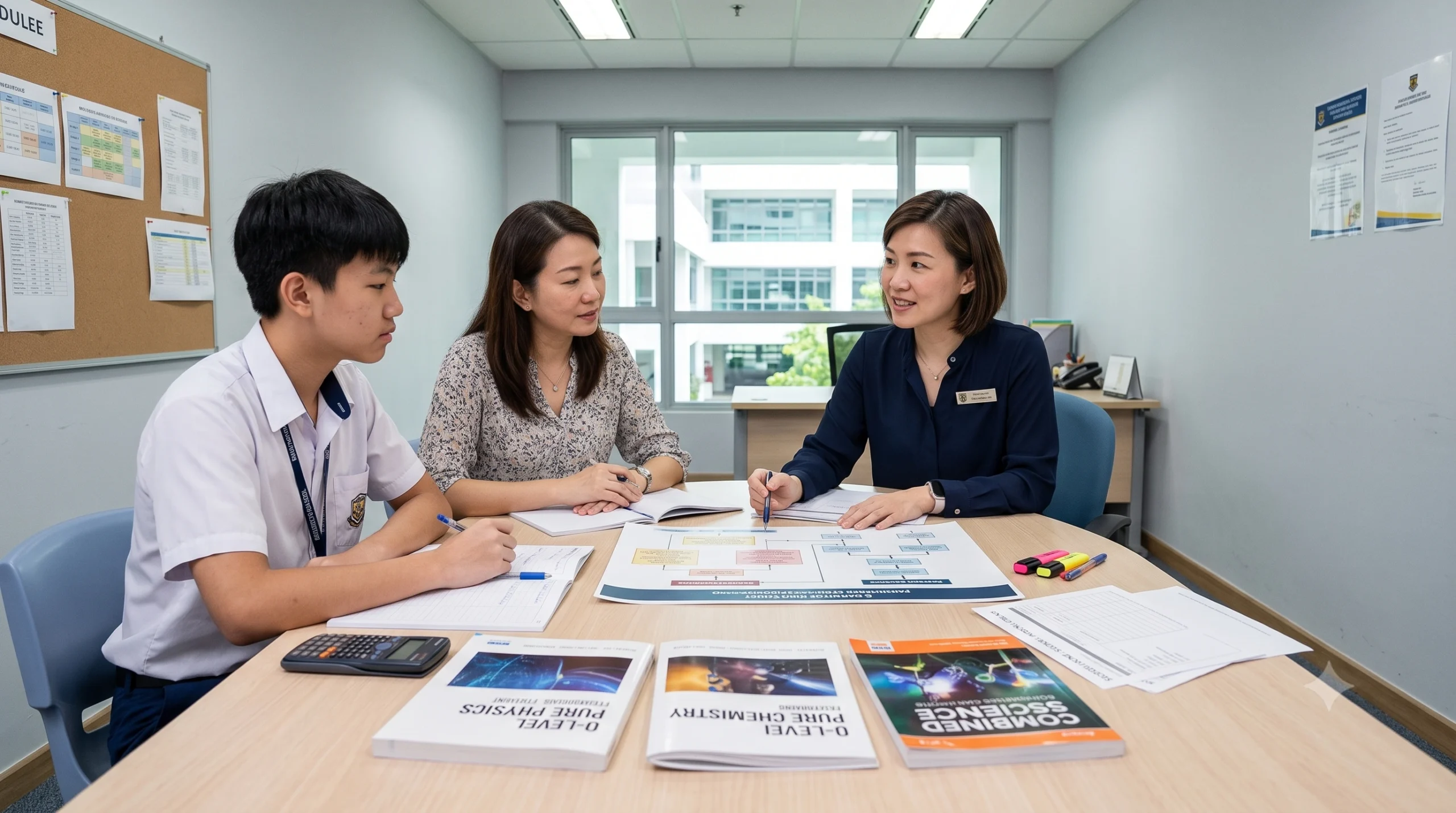
What the Choice Means for Post-Secondary Pathways
The post-secondary implications of this choice are the most important factor for many families, and the ones that generate the most confusion.
For Junior College admission, most JCs require students who wish to take H2 Science subjects to have a relevant O-Level science background. The general pattern, which has remained stable for several years, though families should always check current JC admission requirements directly, is that students from Pure Science backgrounds are better positioned for H2 Physics, H2 Chemistry, and H2 Biology in JC. Students with Combined Science backgrounds may be admitted to H1 versions of these subjects at some JCs, but H2 pathways often require a Pure Science grade.
If your child has aspirations toward science at university, medicine, engineering, computer science, pharmacy, life sciences, the subject combination chosen at Secondary 3 starts to matter from this point.
For polytechnic admission, the picture is different. Most polytechnic diploma programmes accept students with Combined Science backgrounds without disadvantage. Engineering, applied science, biomedical science, and information technology programmes generally do not require Pure Science at O-Level, and Combined Science is a sufficient foundation. If your child’s post-secondary preference leans toward polytechnic, Combined Science does not represent a meaningful disadvantage.
If your child is undecided between JC and polytechnic, or if they are genuinely uncertain about their interest in science-heavy programmes, this is the context in which to have that conversation, ideally before Sec 3 begins, not after the subject combination has been confirmed.
Which Student Profile Suits Each Track
The students most likely to thrive in Pure Science typically share a few characteristics: they have a consistent record of strong performance in school science across Sec 1 and Sec 2, they perform well in subjects that require analytical and mathematical reasoning (including A-Math), and they have identified science-related post-secondary pathways as a priority.
The students most likely to thrive in Combined Science tend to be students who are academically capable but whose strongest interests lie outside of science, in humanities, arts, social sciences, or business. Combined Science allows them to fulfil the science requirement in their subject combination without sacrificing the bandwidth they need for subjects that matter more to their preferred pathway. A student who is genuinely interested in economics, literature, and geography but needs to include a science will often perform better overall with Combined Science than with Pure Science subjects that compete for attention they’d rather give elsewhere.
Students scoring consistently above B3 in secondary science can succeed in either track, provided the rest of their subject combination is reasonable and they have adequate support for the subjects they find most challenging.
If you’re considering combined science tuition or pure physics tuition as part of your child’s Sec 3 support structure, understanding which track they’ll be in before the year begins allows you to plan that support appropriately rather than reactively.
The Decision Timeline
Most secondary schools in Singapore require students to confirm their Sec 3 subject combination, including the choice between Combined and Pure Science, before the end of Sec 2. Confirmation typically happens between September and November of the Sec 2 year, with subject combinations locking in at the start of Sec 3. Changing tracks after Sec 3 begins is very uncommon and requires school approval.
This means the window for making an informed decision is the second half of Secondary 2, which for many families coincides with the period when their child is focused on Sec 2 year-end exams and the full implications of the choice are still somewhat abstract.
The practical advice: begin this conversation in July or August of the Sec 2 year, before exam pressure peaks. Look at your child’s consistent performance across science and mathematics throughout Sec 1 and Sec 2, not just their most recent test. Discuss their post-secondary preferences, even if those preferences are uncertain. And if their school science performance has been inconsistent, understand why before assuming Pure Science is achievable.
Frequently Asked Questions
Can my child switch from Combined Science to Pure Science after Sec 3 starts?
Switching is very uncommon once Sec 3 begins and generally requires school approval. The two tracks have different syllabuses, and catching up on Pure Science content mid-year is a significant additional burden. It is far better to make the right decision before Sec 3 starts than to attempt a track change once the year is underway.
Does taking Combined Science disadvantage my child at top JCs?
For science stream entry at the more academically selective JCs, yes, there can be a disadvantage, particularly for H2 Science subjects where Pure Science background is expected. For non-science JC subject combinations, Combined Science does not create a meaningful disadvantage. The significance depends entirely on your child’s intended post-secondary pathway.
If my child is good at both sciences, is Pure Science always the better choice?
Not necessarily. A student who is good at both sciences but also carries four other subjects may find that Pure Science competes too aggressively for study time and causes overall O-Level performance to drop. Subject combination decisions should account for the full picture of what a student is taking, not just whether they are capable of the harder science option in isolation.
What if my child enjoys science but is not an especially strong student?
Combined Science is likely the better fit. It maintains engagement with science without the depth of content that can overwhelm students who aren’t performing at the top of their cohort. It also frees up time for the subjects where improvement is most needed.
Conclusion
The Combined Science versus Pure Science decision is not a question of which option is better in the abstract, it’s a question of which option is better for a specific student with a specific set of strengths, interests, and post-secondary goals.
High-performing students succeed in both tracks because they choose the track that fits their actual situation, not the one that sounds more impressive. Making this choice with clear information about grading mechanics, subject depth, pathway implications, and your child’s academic profile produces far better outcomes than making it based on what other parents are doing or what seems to signal academic ambition.
If your child is entering Sec 3 and you’re planning their academic support, looking at the right tuition programme for their chosen track early, whether combined science or pure physics, gives you the best chance of building from a stable foundation from the first week of term.