

 Available 24/7
Here’s a situation many P6 parents have witnessed: their child can solve a fraction worksheet correctly, explain the steps clearly, and get every practice question right. Then the same concept appears inside a PSLE Paper 2 problem sum multi-step, worded differently, embedded in a real-world context, and everything stops. The child sits with the pencil hovering, writes something, crosses it out, and eventually circles a guess.
This is not a maths problem. It’s a strategy problem. PSLE Paper 2 problem sums don’t just test whether a child knows how to work with fractions or ratios; they test whether a child can recognise which concept to apply, in what sequence, when the question gives no obvious instructions. The strategies below are the ones that bridge that gap.
Why PSLE Problem Sums Are Harder Than They Look
A standard worksheet question gives you a method: “Find the ratio of A to B.” A PSLE problem sum gives you a situation: “Mrs Tan shared some stickers among her three children. The eldest received 3/5 of the stickers. The remaining stickers were shared equally between the other two children. If the youngest received 40 stickers, how many stickers did the eldest receive?”
The difference is significant. To solve this, a student must:
- Recognise that the remaining stickers are 2/5 of the total
- Understand that the two younger children each got half of that 2/5
- Work out that one child’s share = 1/5 of the total = 40 stickers
- Calculate that 3/5 of the total = 3 × 40 = 120 stickers
No single step is hard. The challenge is reading the question, selecting the right approach, and executing without prompting. PSLE markers consistently report that most marks lost in Paper 2 are not due to wrong calculation, but rather wrong approach selection or incomplete working shown.
Understanding this reframes what good preparation looks like: it’s not about drilling more problems of the same type. It’s about building the habit of strategy-first thinking before writing any calculation.
Strategy 1: The Model Drawing Method (Bar Models)
The Singapore Mathematics curriculum is built on the bar model method, a visual representation of quantities and relationships that makes abstract relationships concrete. It is the most universally applicable PSLE problem sum strategy and should be the first tool a student reaches for when encountering an unfamiliar question.
How it works: Draw rectangles (bars) to represent the quantities in the problem. Use equal-sized units to represent equal portions. Label what you know, leave question marks for unknowns.
Example: Ahmad has twice as many cards as Benny. Ahmad gives 20 cards to Benny. They now have the same number of cards. How many cards did Ahmad have at first?
Before: Ahmad = [■][■], Benny = [■]. After the transfer of 20 cards, they’re equal. The 20 cards transferred represent the difference between one of Ahmad’s units and Benny’s unit, which means 1 unit = 20 cards. Ahmad started with 2 units = 40 cards.
When to use it: Questions involving comparisons between two or more quantities, sharing problems, and before-and-after scenarios. This covers approximately 40–50% of PSLE Paper 2 problems.
The most common mistake: Drawing bars that are not to scale (relative sizes matter) or skipping the model entirely and going straight to calculation, then losing track of what’s being calculated.

Strategy 2: The Before-After Concept for Transfer Problems
A significant category of PSLE problem sums involves a transfer or change of some quantity moved from one person or group to another, and the question asks you to find an original or final amount. The before-and-after concept gives this a structured framework.
The framework:
- Draw a “Before” state with bar models
- Draw an “After” state showing the change
- Identify what stayed the same (the total, usually)
- Use the constant to find unknowns
Example: At first, the ratio of John’s savings to Mary’s savings was 3:1. After John spent $60, the ratio became 1:1. How much did John have at first?
Before: John [■][■][■], Mary [■] total = 4 units After John spent $60: John [?], Mary [■] now equal, so John = 1 unit = Mary
The difference between John’s before and after = $60 = 2 units Therefore 1 unit = $30 John’s original savings = 3 units = $90
When to use it: Questions with ratios that change after a transfer, questions involving “before and after” explicitly or implicitly, and questions where the total stays the same throughout.
Information gains what most students miss: Many before-and-after problems have a hidden constant (usually the total). When you identify what doesn’t change, the problem often becomes straightforward. Train your child to ask: “What stays the same in this problem?”
Strategy 3: Working Backwards for Multi-Step Problems
Some PSLE problems give you the end result and ask you to find the starting value. Students who try to work forward by guessing a starting number and checking waste enormous time. Working backwards is faster and more reliable.
How it works: Start from the given end value and reverse every operation:
- Addition becomes subtraction
- Subtraction becomes addition
- Multiplication becomes division
- Division becomes multiplication
Example: A number is multiplied by 4, then 15 is added, then the result is divided by 3. The final answer is 25. What is the original number?
Working backwards from 25:
- 25 × 3 = 75 (reverse the ÷3)
- 75 − 15 = 60 (reverse the +15)
- 60 ÷ 4 = 15 (reverse the ×4) Original number = 15
When to use it: Problems where the final value is given, and you need the starting value, problems involving multiple sequential operations, problems with the phrase “in the end” or “finally.”
Practice signal: If your child attempts a working-backwards problem by guessing and checking instead, they haven’t internalised this strategy yet. Guessing works on small numbers but fails on harder PSLE problems where the numbers don’t resolve neatly.
Strategy 4: The Unitary Method for Fraction and Proportion Problems
The unitary method is the foundational strategy for any problem involving proportional relationships, fractions, ratios, rates, and percentages. The idea is always the same: find the value of one unit, then scale to what’s needed.
How it works:
- Identify what “1 unit” represents in the problem
- Find the value of 1 unit
- Scale up or down to answer the question
Example: 3/7 of the students in a class are girls. There are 18 girls. How many boys are in the class?
3 units = 18 girls → 1 unit = 6 students Total = 7 units = 42 students Boys = 42 − 18 = 24 boys
When to use it: Any problem involving fractions of a whole (“3/5 of the apples are red”), ratio problems (“the ratio of boys to girls is 4:3”), rate problems (“a tap fills 2/3 of a tank in 20 minutes”).
Common error: Students find the value of one unit but forget to answer the actual question they solve for the wrong quantity. Train your child to re-read the question after finding 1 unit value and confirm what they’re actually being asked.
Strategy 5: Identifying Keywords That Signal the Strategy
One of the highest-leverage things a P5 or P6 student can develop is the habit of scanning a problem sum for strategy-triggering keywords before attempting to solve it. This takes 10–15 seconds and eliminates the “I didn’t know where to start” problem.
Keyword mapping:
| Keywords in the Problem | Strategy to Use |
| “ratio… changed”, “after giving”, “transferred” | Before-After + Bar Model |
| “fraction of”, “what fraction”, “3/5 of the remainder” | Unitary Method + Bar Model |
| “in the end”, “finally”, “at last” + end value given | Work Backwards |
| “altogether”, “combined”, “total” | Bar Model showing groups |
| “rate”, “per hour”, “per day” | Unitary Method |
| “% more than”, “% less than”, “% of the original” | Percentage + Unitary |
| “Each received an equal amount.” | Division unit identification |
This is not a memorisation exercise, it’s a reading habit. Students who practise this consistently stop feeling like problem sums are unpredictable and start recognising the underlying structure beneath the varied wording.
How to Practise Problem Sums Effectively at Home
Practice quality matters more than practice quantity. Here’s how to structure it:
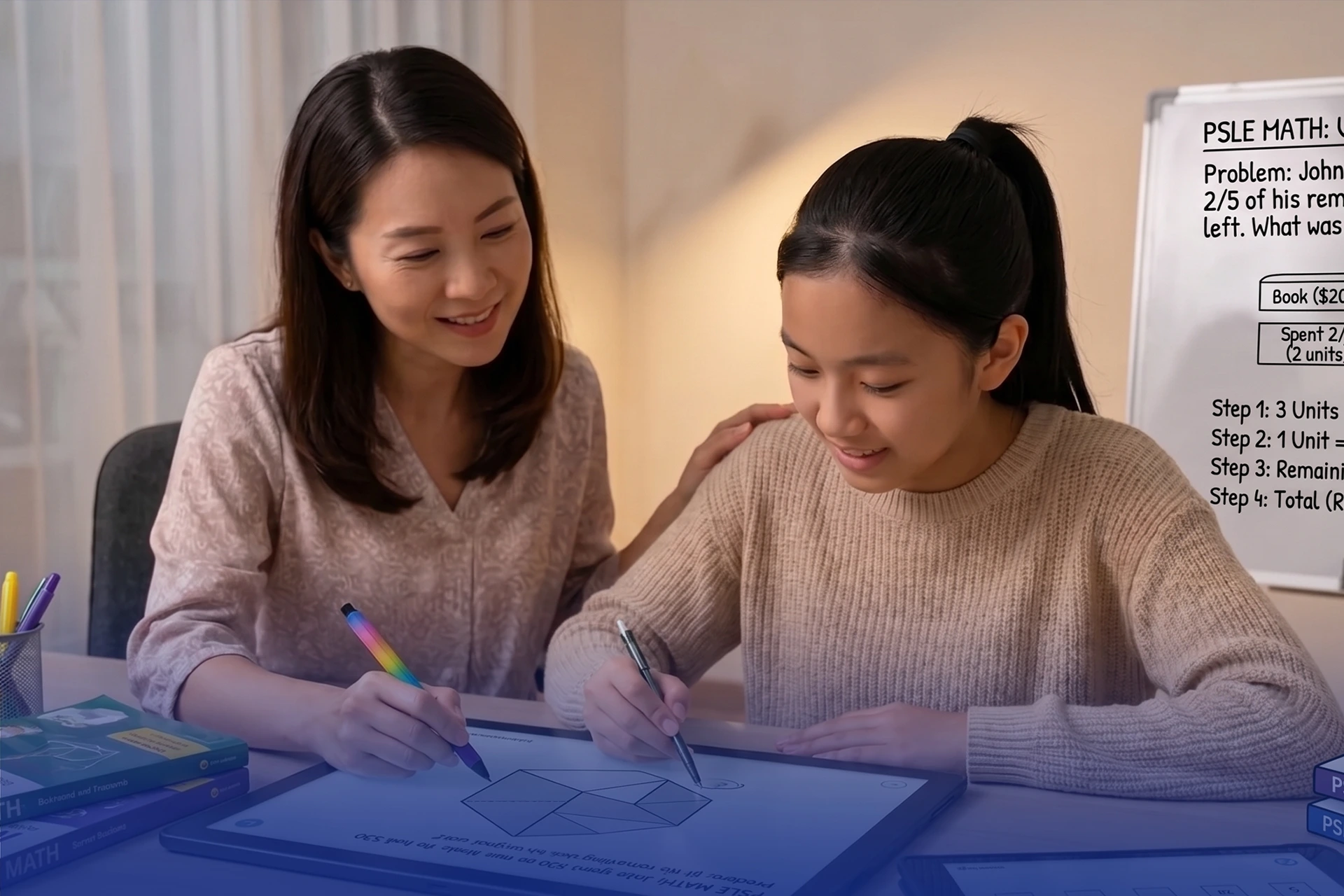
- Attempt first, check method second. Your child should attempt the problem completely before you review. If you intervene midway, they don’t develop the problem-selection instinct; they wait for the hint.
- Review the strategy, not just the answer. After checking the answer, the question to ask is not “were you right?” but “which strategy did you use, and was it the most efficient one?” A child who got the right answer by guessing and checking should learn the more systematic approach, even though they got it right.
- Do topic clusters before mixed practice. In early preparation (P5 and early P6), practise ratio problems together, then percentage problems together, then mixed. This builds strategy-to-topic associations. Once associations are solid, move to mixed practice to build selection ability.
- Time the practice, but don’t start there. Don’t introduce timed conditions until your child has reasonable fluency with the strategies. Timed practice before strategy fluency teaches children to rush, not to think. Start timing in P6 Term 2 onwards, and gradually reduce the time allowance.
At Arche Academy, PSLE Maths sessions are structured around strategy-first teaching, students to identify the approach before they calculate, and this habit is reinforced across every session. Classes are capped at six students so tutors can observe and correct approach errors in real time.
Learn more about our PSLE Maths classes →
Frequently Asked Questions
How many problem sum strategies does a P6 student need to know?
The five strategies covered in this article bar models, before-and-after, working backwards, unitary method, and keyword identification cover over 85% of PSLE Paper 2 problem sum types. Breadth is less important than depth: a student who can fluently apply these five strategies to unfamiliar problems is better prepared than one who has a superficial familiarity with ten strategies.
My child knows the strategy but still gets the answer wrong. Why?
The most common reasons: incorrect identification of what “1 unit” represents, arithmetic errors in multi-step calculations (especially with larger numbers), and misreading what the question actually asks. Encourage your child to always re-read the final question after completing their work, before circling an answer.
Are PSLE problem sums always multi-step?
Paper 2 questions range from 2-mark (single-step) to 5-mark (multi-step). The 4- and 5-mark questions are almost always multi-step and require two or more strategies in sequence. These questions account for the majority of the marks that differentiate AL1 from AL2 students.
Should my child memorise problem-solving types or learn strategies flexibly?
Flexible strategy application, without question. PSLE setters deliberately vary question wording and context to test whether students understand the concept, not whether they’ve seen an identical question before. Children who rely on memorised templates are consistently tripped up by slight variations. Children who understand the underlying strategy adapt naturally.
Final Thoughts
PSLE Paper 2 problem sums are solvable for every single one. They’re not designed to trick students who are well-prepared; they’re designed to distinguish students who can think systematically from those who can only follow familiar patterns. The five strategies in this guide build systematic thinking directly.
The shift from “I don’t know where to start” to “I can identify the right approach within 30 seconds” doesn’t happen through exposure alone it happens through deliberate strategy-first practice, reviewed carefully with someone who can identify where the thinking breaks down. That’s what good PSLE Maths tuition provides.
Explore Arche Academy’s PSLE Maths programme →