

 Available 24/7
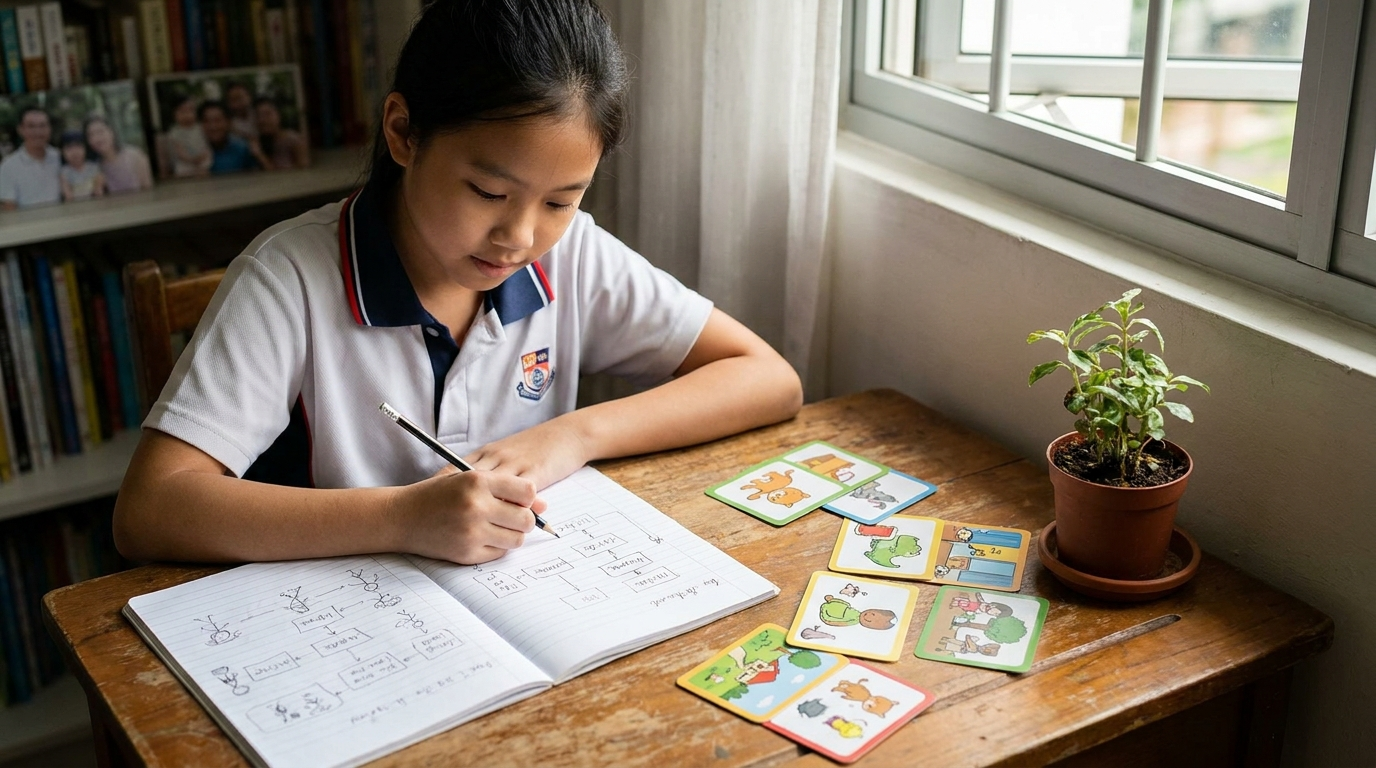
Ask a P6 student what makes a good composition and most will say “good vocabulary” or “a nice ending”. Ask a PSLE marker and you get a different answer: a story that is well planned, clearly structured, and controlled from start to finish. The gap between those two answers is exactly where most compositions lose marks.
A Band-1 story is not the product of a sudden burst of inspiration in the exam hall. It is the result of a repeatable method — one a child can learn and apply to any picture prompt they are given. This guide walks through that method step by step.
What a Band-1 Composition Is Actually Marked On
PSLE continuous writing is assessed on two things: content and language. Content is whether the story is relevant to the topic, well developed, and coherent. Language is the accuracy and range of the writing — vocabulary, sentence structure, and grammar.
The important insight for parents is that these two are marked together. A child with dazzling vocabulary but a thin, rushed plot will not reach Band 1, and neither will a child with a strong plot written in flat, error-filled language. The top band belongs to stories that are both well told and well written — which is why a method that builds the story first, then dresses it in language, works better than chasing “good words”.
Step 1: Read the Prompt and Plan Before Writing
The single biggest predictor of a Band-1 composition is whether the child planned before writing. PSLE gives a theme and picture prompts, and the temptation is to start writing immediately. The stronger move is to spend a few minutes deciding the plot, the characters, and — crucially — the one main event the story will build towards.
A quick plan prevents the most common failures: a story that wanders, a plot that resolves too fast, or an ending bolted on because time ran out. Even a rough plan of beginning, build-up, climax, and resolution gives the writing a shape the marker can follow.
Step 2: Build a Clear Story Structure
A Band-1 story has a recognisable arc. It opens with a hook that sets the scene and introduces a character the reader can follow. It develops through a build-up that raises tension or curiosity. It reaches a clear climax — the main event the plan was built around. And it closes with a resolution that feels earned, not rushed.
The most common structural weakness is spending too long on the build-up and too little on the climax and resolution, so the story runs out of steam. Teaching a child to pace the story — to reach the main event with enough time and words left to do it justice — lifts more compositions than any amount of vocabulary drilling.
Step 3: Show, Don’t Just Tell
The writing techniques that earn language marks are learnable. Instead of “he was scared”, a Band-1 writer shows the fear — a racing heart, a held breath, a step backwards. Sensory detail, varied sentence lengths, and well-placed dialogue turn a flat recount into a story that holds the reader.
The goal is not to cram in every “good phrase” a child has memorised. Overloaded, forced vocabulary reads worse than clean, controlled writing. The skill is using the right technique at the right moment — a vivid image at the climax, a short sharp sentence to build tension — so the language serves the story rather than showing off.
Building this range of expression is the same work that lifts comprehension performance too; our guide to improving PSLE composition and comprehension covers how the two reinforce each other, and a strong PSLE vocabulary foundation gives a child the raw material to draw on.
Step 4: Leave Time to Check
Language marks are quietly lost in the last five minutes — or rather, in not having them. A child who finishes with time to reread their work will catch the tense slips, missing words, and punctuation errors that pull a composition out of Band 1.
Building this habit means practising compositions under timed conditions, so that finishing with time to spare becomes normal rather than a lucky exception. A story that is planned, paced, and checked will almost always outscore one written in a single unbroken rush.
Turning the Method Into a Habit
The reason this method works is that it replaces inspiration with a process. A child who knows how to plan, structure, develop, and check a story is no longer at the mercy of whether the prompt “suits” them — they can produce a strong composition on any topic.
That consistency is what tuition builds. A tutor reading a child’s compositions can see exactly where the method breaks down — a weak plan, a rushed climax, telling instead of showing — and coach the specific habit that fixes it.
Ready to get started? Explore our English Tuition programme
Frequently Asked Questions
What is a Band-1 PSLE composition?
It is a composition that scores in the top band for both content and language — a relevant, well-developed, coherent story written with accurate and varied language. Both elements are required; strong writing with a thin plot, or a strong plot in weak language, will not reach Band 1.
How do you plan a PSLE composition quickly?
Decide the plot, the characters, and the one main event the story builds towards, then sketch a simple beginning–build-up–climax–resolution outline. A few minutes of planning prevents wandering plots and rushed endings, which are the most common reasons compositions miss the top band.
Does vocabulary matter for a Band-1 story?
Vocabulary helps, but only in service of the story. Forced or overloaded “good phrases” read worse than clean, controlled writing. The strongest compositions use the right technique at the right moment rather than cramming in memorised words.
How can my child improve composition writing at home?
Practise under timed conditions using past picture prompts, plan before writing every time, and reread the finished piece for errors. Reviewing each composition against what content and language actually reward — rather than just writing more — is what drives improvement.
When should PSLE English tuition start for composition?
P5 is a good time to build the planning-and-structure method so it is automatic by P6. Many families also seek targeted help in P6 when compositions are strong in ideas but inconsistent in language, or vice versa.
A Band-1 story is within reach of most children once they stop treating composition as a talent they either have or lack and start treating it as a method they can follow. Plan the story, structure it clearly, show rather than tell, and leave time to check — repeated across enough practice, that process is what turns an average composition into a Band-1 one.