

 Available 24/7
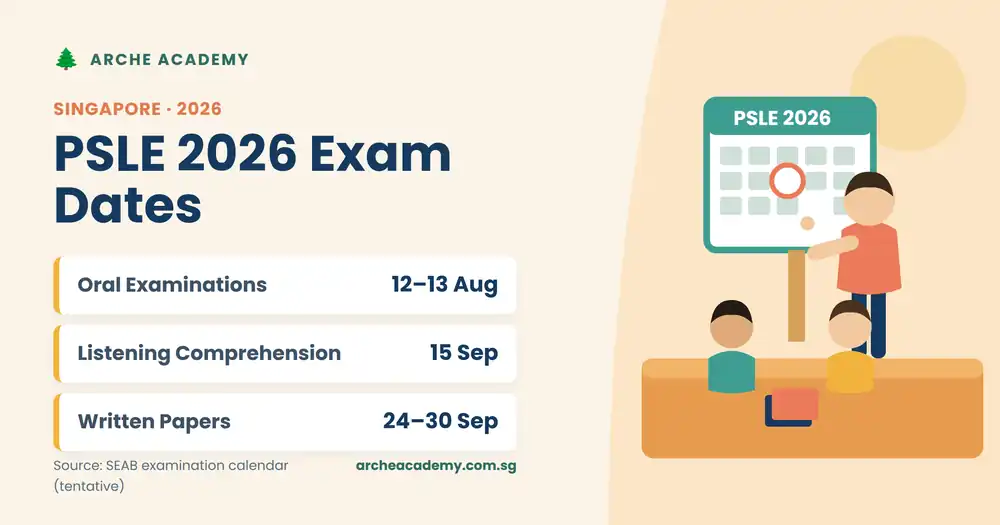
PSLE 2026 results are tentatively released between Tuesday 24 and Wednesday 25 November 2026, according to MOE. Before that, the PSLE 2026 marking days are Monday 12, Tuesday 13 and Wednesday 14 October 2026, when primary schools close for P1 to P5 pupils so teachers can mark PSLE scripts. School resumes for all levels on Thursday 15 October. The written papers run from 24 to 30 September 2026, after the Listening Comprehension paper on 15 September and the Orals on 12 and 13 August. Below is the full timetable by subject, how AL scoring works, and what happens between results day and Secondary 1 posting. If your child is in Primary 5, the dates to plan around are in our PSLE 2027 exam dates and timeline.
When Is PSLE 2026? The Full Exam Timetable
PSLE 2026 written papers are held from 24–30 September 2026. Oral examinations take place on 12–13 August 2026 and the Listening Comprehension paper on 15 September 2026. The table below sets out every component by subject and date, based on the SEAB examination calendar.
| PSLE 2026 Component | Date |
|---|---|
| Oral Examinations (English & Mother Tongue) | Wed–Thu, 12–13 August 2026 |
| Listening Comprehension (Mother Tongue & English) | Tue, 15 September 2026 |
| English (Paper 1 & Paper 2) | Thu, 24 September 2026 |
| Mathematics (Paper 1 & Paper 2) | Fri, 25 September 2026 |
| Mother Tongue (Paper 1 & Paper 2) | Mon, 28 September 2026 |
| Science | Tue, 29 September 2026 |
| Higher Mother Tongue | Wed, 30 September 2026 |
| PSLE marking days (P1–P5 no school) | 12–14 October 2026 |
| PSLE 2026 results release (tentative) | Tue–Wed, 24–25 November 2026 (tentative, per MOE) |
Dates follow the SEAB examination calendar. MOE gives a tentative results window of 24 to 25 November 2026, and the exact day is confirmed closer to the release (the 2025 results came out on 25 November 2025). Always check MOE’s national examinations page for the final confirmed timetable.
When Are the PSLE 2026 Marking Days?
The PSLE 2026 marking days are Monday 12, Tuesday 13 and Wednesday 14 October 2026. On these three days primary schools close for Primary 1 to Primary 5 pupils so that teachers can mark PSLE scripts. Primary 6 students have already sat their papers. School resumes for all levels on Thursday 15 October 2026.
| PSLE 2026 marking day | What happens |
|---|---|
| Mon, 12 October 2026 | No school for P1–P5 |
| Tue, 13 October 2026 | No school for P1–P5 |
| Wed, 14 October 2026 | No school for P1–P5 |
| Thu, 15 October 2026 | School resumes for all levels |
For most families the practical consequence is three weekday mornings in mid-October that need cover. Holiday programmes and student care in that week fill early, so it is worth deciding in September rather than the week before.
When Is the PSLE 2026 Listening Comprehension Paper?
The PSLE 2026 Listening Comprehension paper is on Tuesday, 15 September 2026, covering both English and Mother Tongue. It falls nine days before the written papers begin on 24 September 2026, and about a month after the Oral examinations on 12–13 August 2026. It is the last paper before the main written window opens.
What PSLE 2026 Represents in Today’s Education System

The Role of PSLE in Singapore’s Academic Pathway
The Primary School Leaving Examination remains a placement examination, not a ranking contest. Its purpose is to match students to a secondary school course that aligns with their academic readiness across subjects.
PSLE 2026 continues this intent. It assesses how well a student demonstrates syllabus mastery under standardised conditions set by the Ministry of Education and administered by the Singapore Examinations and Assessment Board.
Why Parents Feel More Uncertain Than Before
Uncertainty has increased not because PSLE is harsher, but because outcomes now look less predictable. The shift to Achievement Levels removed relative ranking and replaced it with fixed performance standards.
Parents seeking context on how these changes affect preparation often refer back to PSLE-related guidance shared in the Arche Academy education blog, which explains how exam structures translate into real student outcomes.
PSLE 2026 Exam Timeline and Key Milestones

Why the Timeline Matters More Than the Dates
The PSLE exam timeline shapes preparation priorities. By the time written papers begin in late September:
- Content learning should already be complete
- Students should be in revision and exam-calibration mode
- Weak areas must be stabilised, not newly introduced
Effective planning treats the exam window as fixed and works backward from it. Students who begin structured revision early, rather than waiting, protect valuable preparation time.
Understanding PSLE AL Scoring Without the Confusion
How the Achievement Level System Works
PSLE AL scoring uses eight achievement levels, from AL1 to AL8, for each subject. Each AL represents a defined performance band tied to syllabus standards, not cohort performance.
A student’s total PSLE score is the sum of ALs across four subjects, ranging from 4 (best) to 32. Lower totals indicate stronger overall performance and open up more secondary school options.
Why Consistency Beats Peak Performance
Under AL score bands, a student scoring AL4 consistently across subjects often has a stronger placement outcome than one with extreme variation. This is because:
- Secondary school posting considers total score
- Balanced mastery reflects readiness across disciplines
- Gaps are harder to remediate after primary school
This is a structural reality of PSLE AL scoring, not a motivational slogan.
For the full AL mark bands (the exact marks each level needs) and precisely how the total maps to Secondary 1 posting under Full Subject-Based Banding, see our dedicated guide: PSLE Scoring Explained: AL Bands and Secondary Posting.
Subject Weightage and What It Really Means
Equal Weight Does Not Mean Equal Strategy
All PSLE subjects carry equal numerical weight, but preparation effort should not be identical. Each subject tests different competencies:
- English emphasises comprehension, clarity, and applied language use
- Mathematics focuses on reasoning and method
- Science tests concept application and explanation
- Mother Tongue assesses language accuracy and contextual use
Students should allocate time based on learning gaps, not subject labels.
English as a Leverage Subject
English often acts as a differentiator because it influences performance across other subjects. Strong comprehension skills support Science and problem-solving questions in Mathematics. For families targeting Math specifically, our PSLE Math tuition and PSLE Science tuition programmes drill exactly this application-under-pressure skill.
What Students Should Focus On for PSLE 2026
From Content Coverage to Application Control
Most PSLE 2026 students will complete the syllabus by mid-year. What matters next is:
- Applying concepts to unfamiliar formats
- Managing time under exam conditions
- Avoiding repeated careless errors
Practice without reflection does not build these skills.
Exam Readiness Is a Skill Set
Exam readiness includes:
- Knowing when to move on from a question
- Structuring answers for marks, not elegance
- Staying composed after mistakes
These behaviours can be trained. They are not personality traits.
When Will PSLE 2026 Results Be Released?
PSLE 2026 results are tentatively released between Tuesday 24 and Wednesday 25 November 2026, according to MOE. The exact day is confirmed closer to the release; as a reference point, the 2025 results came out on 25 November 2025. Results are collected by parents from the child’s primary school, and the Secondary 1 (S1) Posting exercise follows shortly after. The window between results and S1 posting is when families finalise school choices, so it helps to have a shortlist ready before results day. Once you have the score, you can check it against every secondary school’s cut-off point to see which schools are realistically in range. For schools near Hougang, Kovan, Serangoon, Sengkang and Punggol, our list of nearby secondary schools and their cut-off points puts all 23 in one table.
The Role of Schools, Tuition, and Home Support
How Schools Prepare Students
Primary schools align instruction with the MOE PSLE structure. Teachers focus on syllabus coverage, assessment exposure, and class-wide readiness. Individual gaps, however, are harder to address at scale.
Where Targeted Support Makes Sense
Tuition works best when it:
- Diagnoses recurring errors early
- Re-teaches concepts using different explanations
- Trains exam decision-making deliberately
Tuition that only increases workload rarely improves PSLE performance.
Managing Stress Without Reducing Standards
Why Stress Peaks in PSLE Years
Stress rises when expectations are unclear. Students worry more when they do not understand how they are being assessed or why marks fluctuate. Clear benchmarks, consistent feedback, and predictable routines reduce anxiety more effectively than reassurance alone.
What Parents Can Control
Parents influence outcomes by:
- Keeping routines stable during the school term
- Avoiding daily mark interrogation
- Focusing on preparation behaviours, not predictions
Children perform better when adults around them are calm and consistent.
What PSLE 2026 Is Not
PSLE 2026 is not:
- A test of who memorised the most
- A race to finish the most assessment books
- A predictor of lifelong success
It is a structured checkpoint designed to place students into appropriate secondary pathways.
Conclusion
PSLE 2026 rewards students who are clear, balanced, and ready more than those who are simply intense. Preparation is far less stressful once you know when each paper falls, how the AL scoring system works, and what the real focus areas are. With the written papers on 24–30 September 2026 and results tentatively due on 24 to 25 November, the runway is defined — the task now is to use it well.
If your child is preparing for PSLE 2026, look for support that focuses on structured study, skill transfer, and exam confidence rather than sheer drill volume. Find out how Arche Academy helps PSLE students get exam-ready and make sense of their learning.
Sec 1 head-start offer: join our Sec 1 maths or science class by 31 December 2026 and get 10% off the monthly tuition fee for your first two months.
Starting Sec 1 in 2027
Sec 1 maths moves quickly: algebra widens and speed becomes new content. Our Sec 1 maths and science classes are capped at five students, at Blk 208 Hougang Street 21 near Kovan MRT.
Secondary maths tuition · Secondary science tuition · Book a trial lesson →
FAQs About PSLE 2026
When will PSLE 2026 take place?
PSLE 2026 written papers are held from 24–30 September 2026, with Oral examinations on 12–13 August and the Listening Comprehension paper on 15 September 2026, per the SEAB examination calendar. English is on 24 Sep, Mathematics on 25 Sep, Mother Tongue on 28 Sep, Science on 29 Sep, and Higher Mother Tongue on 30 Sep. Check MOE’s national examinations page for the final confirmed timetable.
When will PSLE 2026 results be released?
PSLE 2026 results are tentatively released between Tuesday 24 and Wednesday 25 November 2026, according to MOE. The exact day is confirmed closer to the release; the 2025 results came out on 25 November 2025. Results are collected from the child’s primary school and are followed by the Secondary 1 Posting exercise.
When are the PSLE 2026 marking days?
The PSLE 2026 marking days are 12, 13 and 14 October 2026. Primary schools close for P1 to P5 pupils on those three days while teachers mark PSLE scripts, and school resumes for all levels on Thursday 15 October 2026.
Do P6 students go to school on PSLE marking days?
No. Primary 6 students have already completed their papers by mid-October, and P1 to P5 pupils have no school on 12–14 October 2026. Arrangements for student care vary by school, so check your school’s circular.
When is the PSLE 2026 Listening Comprehension paper?
The PSLE 2026 Listening Comprehension paper is on Tuesday, 15 September 2026, for both English and Mother Tongue — nine days before the written papers start on 24 September 2026.
How does PSLE AL scoring affect secondary school posting?
Each subject receives an Achievement Level from AL1 to AL8. The total score across four subjects (from 4 to 32, where lower is better) determines secondary school options.
Should students focus more on weaker subjects?
Yes. Since all subjects carry equal weight, improving a weaker subject often reduces the total PSLE score more effectively than perfecting a strong one.
Is PSLE 2026 harder than previous years?
The standard is consistent. What has changed is the scoring system, which makes preparation gaps more visible earlier.
How early should PSLE 2026 preparation start?
Foundational preparation should begin in Primary 5, with Primary 6 focused on refinement and exam readiness.