

 Available 24/7
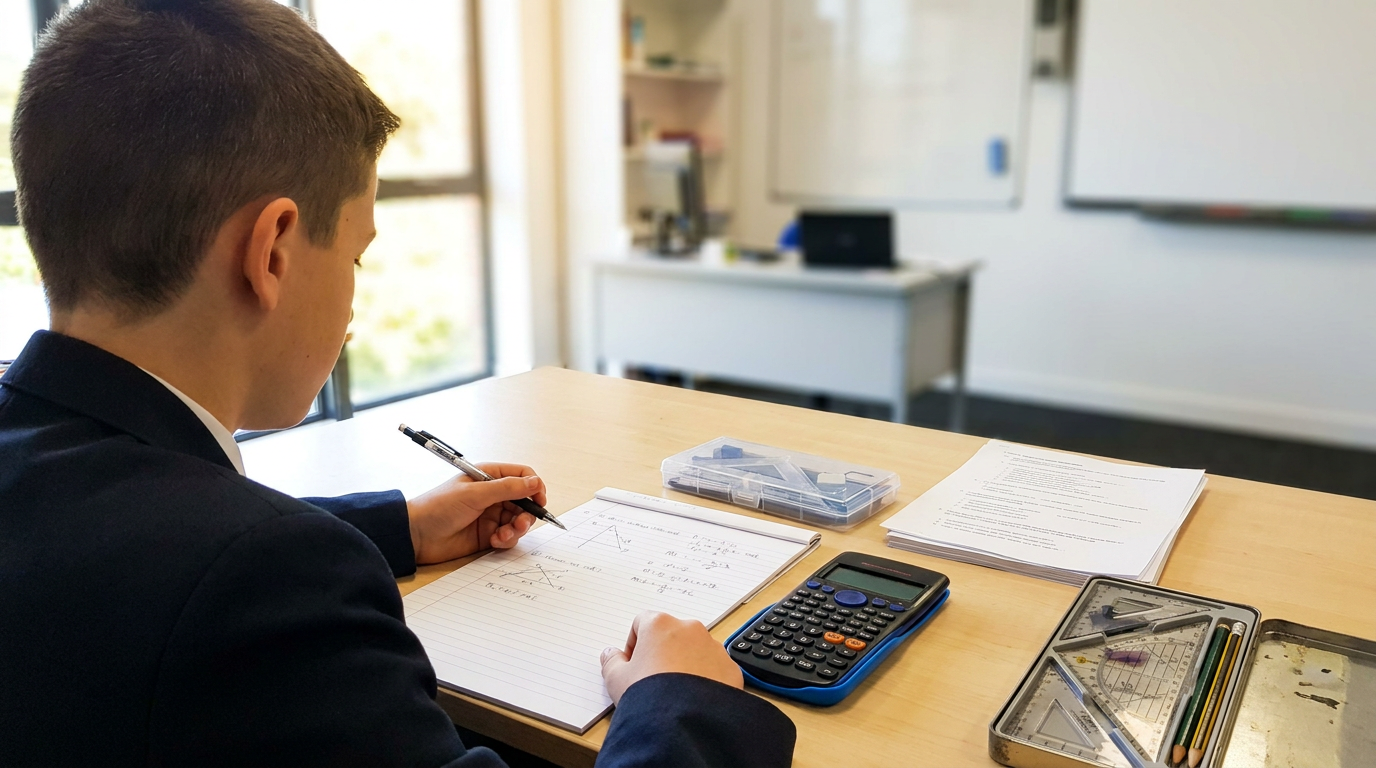
In O-Level Elementary Mathematics, a handful of topics decide most grades: algebraic manipulation, trigonometry and bearings, vectors, mensuration, and the multi-topic problem sums that pull several skills into one question. The paper does not reward a student for knowing more topics; it rewards clean working and accurate arithmetic under time pressure. Most of the marks a student calls “careless” are lost to messy presentation and skipped checking, not to a gap in understanding. Revise by diagnosing which of those topics actually leak marks, drilling those in short focused sets, then sitting full timed papers so the exam stops being a surprise.
E-Maths (examined under SEAB syllabus 4052, the code that replaced 4048) covers three strands: Number and Algebra, Geometry and Measurement, and Statistics and Probability. A student who is roughly a B3 and wants an A2 rarely needs to relearn the syllabus. They need to stop bleeding two or three marks per question on avoidable errors. This is for parents of a Sec 3 or Sec 4 student who sees the ability but keeps seeing the grade fall short.
Reviewed by Tutor Glen, O-Level Mathematics tutor at Arche Academy.
What E-Maths actually tests
The exam is two written papers, each 2 hours 15 minutes, each worth 90 marks, and each counts for half the grade. There is no coursework and no shortcut paper. Both papers can draw from anywhere in the syllabus, so a topic you hoped to skip in Paper 1 can reappear in Paper 2. You can confirm the current code and structure on the SEAB list of O-Level syllabuses for school candidates; the O-Level itself sits inside the national secondary curriculum run by the Ministry of Education.
Because the marks split evenly across the whole syllabus, the grade is decided less by which topics a student knows and more by how reliably they convert what they know into marks on the page. That distinction shapes everything below.
The topics where grades are won and lost
Some topics are heavy because they carry marks; others are heavy because they trip people up. These are the ones I watch most closely, and the specific way each one leaks marks.
Algebraic manipulation runs underneath almost every question. A sign error in the second line of an expansion follows the student all the way to a wrong final answer, and it usually costs the accuracy mark on everything downstream. Trigonometry and bearings punish students who reach for the calculator before drawing the diagram: a bearing measured from the wrong reference line, or a calculator left in the wrong angle mode, produces a confident answer that is simply wrong. Vectors reward precision in notation. Muddle a position vector with a direction vector, or subtract two points in the wrong order, and the geometry falls apart even when the method is sound.
Mensuration is where formula slips hide. Students mix up surface area and volume, forget to include both circular ends of a cylinder, or round part way through when the question wanted an exact answer in terms of pi. Then there are the multi-topic problem sums, the ones that fold algebra into geometry into a rate of change. These are the highest-value questions on the paper and the most common place to stop one step short of what was actually asked.
The table below pairs each area with the error I see most often and the habit that fixes it.
| Topic or area | Where marks leak | The fix |
|---|---|---|
| Algebraic manipulation | Sign errors expanding brackets; dropping a term when transposing | Slow down the first two lines; write every step, no mental jumps |
| Trigonometry and bearings | Bearing measured from the wrong point; calculator in the wrong angle mode | Draw and label the diagram first; mark north; check the mode before pressing equals |
| Vectors | Confusing position and direction vectors; subtracting points in the wrong order | Label every point; write the route as a sum of named vectors |
| Mensuration | Surface area vs volume mix-ups; forgetting units or an exact pi answer | State the formula before substituting; re-read what form the answer must take |
| Multi-topic problem sums | Reading the wrong quantity; stopping before the final part | Underline exactly what is asked; re-read the question after writing the answer |
None of these fixes is about knowing more mathematics. They are about handling the mathematics the student already has.
The “careless mistakes” problem is usually a presentation problem
When a parent tells me their child “just makes careless mistakes,” I have learned to treat that as a specific, fixable pattern rather than a personality trait. Nine times out of ten it is not a knowledge gap. It is a working-presentation habit and a checking habit, and both can be trained.
Here is what I mean. E-Maths awards method marks. If a student writes out the correct steps and then fumbles the final arithmetic, they still keep the method marks for that question. If that same student does the whole thing in their head and writes only the final number, one slip loses the lot. So the student who “shows less working because they find it fast” is quietly the higher-risk student. They have removed the very thing the marker uses to give partial credit.
The first thing I change with a new E-Maths student is almost never a topic. It is the layout of their working. One line per step. The formula written before the numbers go in. The answer boxed, with units, checked against the question. That single change often lifts a student half a grade before we touch a single new concept, because it stops the bleeding and it gives the marker something to reward. The second change is a deliberate final read: after the answer is written, go back and confirm it answers the exact question asked, in the exact form asked for. Cheap to teach, and it recovers marks every paper.
A worked illustration: how one problem sum leaks marks
Picture a two-part question. Part (a) gives a solid metal cylinder and asks for its total surface area. Part (b) gives the density of the metal and asks for the mass of the cylinder, using the volume.
A capable student who rushes does this: for part (a) they work out the curved surface area, write the number, and move on, forgetting the two circular ends. Wrong answer, and because they showed only the final figure, no method mark either. For part (b) they multiply density by the wrong quantity, never pausing to ask whether mass comes from volume or from area.
Now the same student, with the working habit in place. Part (a): they write the two formulas first, curved surface plus two ends, substitute, and even if they slip on the arithmetic they keep the method marks because the steps are on the page. Part (b): they write “mass = density times volume,” which forces them to notice they need volume, not surface area. Same ability, same eleven minutes, several more marks. The difference was entirely in how the work was set out and checked, not in what the student knew.
How to revise E-Maths so it actually holds
Random practice feels productive and mostly is not. A tighter loop works better, and it has three stages.
- Diagnose before drilling. Do not revise topics evenly. Mark up two recent papers and find the three or four topics that actually cost the student marks. That is the revision list. Everything already scoring well can wait.
- Drill those topics in short, focused sets. Ten questions on bearings in one sitting beats one bearings question buried in a mixed paper, because the student builds and holds the specific technique. Keep the working-presentation rule switched on for every question, even the easy ones, so the habit is automatic by the exam.
- Sit full timed papers. Once the weak topics are steadier, do complete papers under exam time. This trains pacing, teaches the student which questions to leave and come back to, and turns the format into something familiar rather than a shock on the day.
For a sense of how a structured revision schedule looks across a term, our O-Level science 12-week revision plan uses the same diagnose-drill-time approach, and it maps cleanly onto maths.
One more decision worth naming. Plenty of students take Additional Mathematics alongside E-Maths, and the two reward slightly different things. If you are weighing whether your child should carry both, our comparison of A-Maths versus E-Maths lays out the workload honestly, and in a small group we can run E-Maths and O-Level Additional Maths support in parallel without either subject getting starved.
Frequently Asked Questions
Which E-Maths topics should my child revise first?
Start with the topics that are actively losing marks in their recent papers, not the ones that feel hardest in the abstract. For most students that means algebraic manipulation, trigonometry and bearings, and the multi-topic problem sums. Diagnose from two marked papers, then drill the three or four weakest areas rather than reviewing everything evenly.
Are E-Maths careless mistakes a sign my child does not understand the topic?
Usually not. In the classroom, most “careless” marks are lost to skipped working and no final check, not to a gap in knowledge. A student who writes one line per step keeps method marks even when they slip on arithmetic, so fixing presentation often recovers half a grade before any new teaching.
How is O-Level E-Maths graded?
It is two written papers, each 2 hours 15 minutes and each worth 90 marks, weighted equally at 50 percent each. Both papers can test any part of the syllabus, so students cannot safely drop a topic hoping it only appears in one paper.
How many marks come from showing working?
Method marks are awarded across the paper for correct steps, even when the final answer is wrong. That is why writing out every step matters: a student who shows only the final number risks losing the whole question to a single slip, while one who lays out the method keeps partial credit.
Should my child take A-Maths as well as E-Maths?
It depends on their current E-Maths standard and their intended junior college or polytechnic path. A-Maths is heavier and assumes fluent algebra, so a student still leaking marks on E-Maths basics should steady those first. Our E-Maths versus A-Maths comparison covers the trade-off in detail.
How long before the exam should serious revision start?
Give it a full term of structured work rather than a last-month cram. A term lets you diagnose weak topics, drill them properly, and still fit in several full timed papers. Compressed revision tends to reinforce the presentation habits that lose marks in the first place.
Where to start
If your Sec 3 or Sec 4 child has the ability but keeps landing a grade below what you expected, the fastest gain is rarely a new topic. It is a tutor who watches how they set out and check their working, in a group small enough to catch it every lesson. Our classes are capped at five students, so nothing gets missed. Come and see it: book a trial class for O-Level Elementary Maths and we will show you exactly where the marks are leaking and how to stop it.