

 Available 24/7
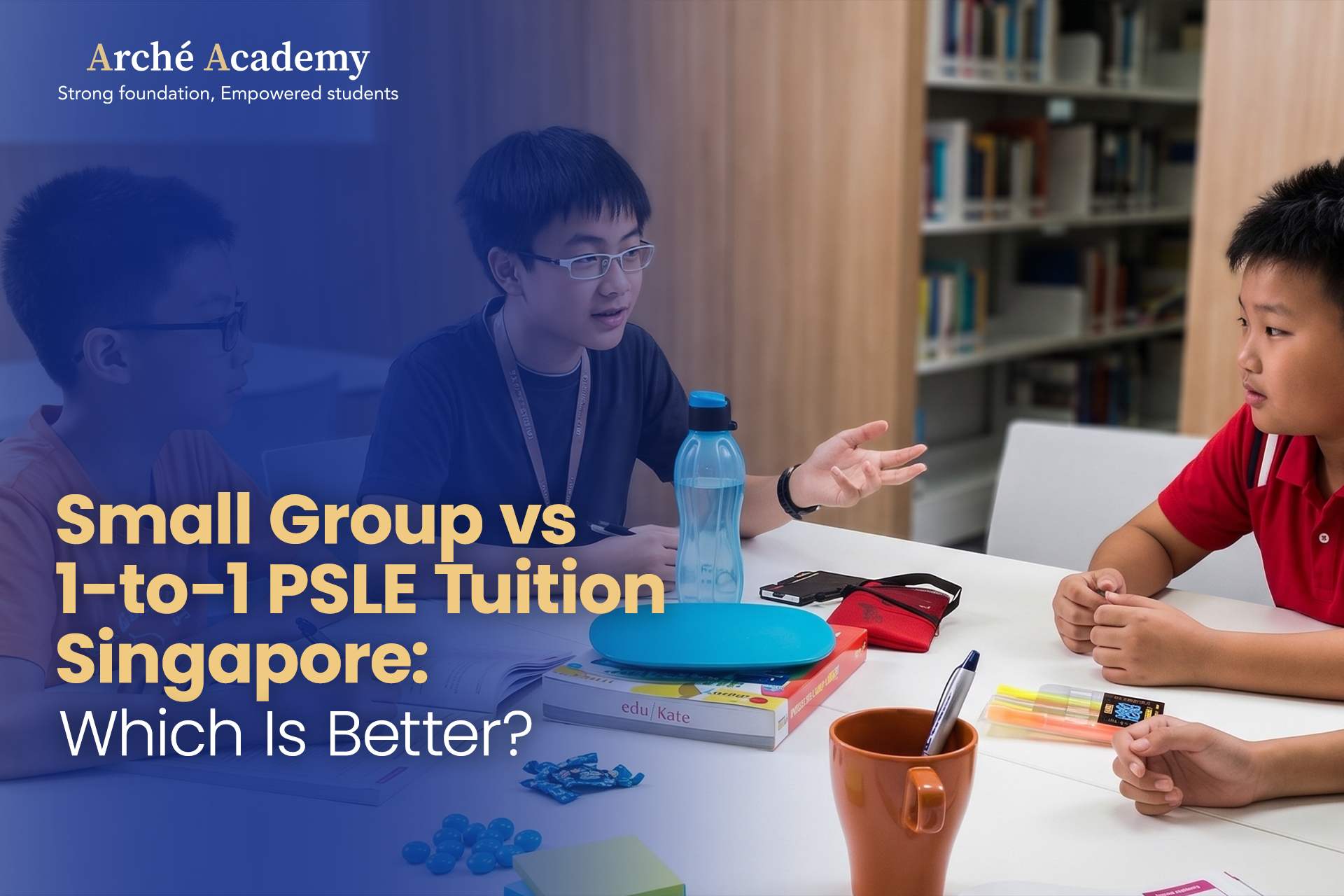
Choosing between small group tuition and private 1-to-1 tuition is one of the most consequential decisions parents make when preparing their child for PSLE. Both formats work, but they work for different students, under different circumstances, and for different reasons. Getting the choice right means knowing which factors actually matter, rather than defaulting to the more expensive option on the assumption that it must be better.
This guide lays out a clear, honest comparison of both formats so you can make a decision based on your child’s actual learning profile, not on marketing.
What Is Small Group Tuition?
Small group tuition in Singapore typically involves between 4 and 10 students in a class led by one tutor. At quality centres, the upper limit is kept deliberately low, often 5 students, to ensure each student receives meaningful attention during the session.
Sessions follow a structured curriculum, with the tutor teaching new content or techniques, assigning practice, and providing feedback within the class. Students benefit from a shared learning environment where questions asked by one student often illuminate gaps for others.
What Is 1-to-1 Tuition?
Private 1-to-1 tuition means a single tutor working exclusively with one student. All instruction, attention, and feedback are directed at that individual. The tutor can move at the student’s pace, pivot immediately when a concept is not understood, and tailor every session to the specific weaknesses the student presents.
Sessions are typically conducted at home or at a tutor’s premises, and scheduling is more flexible than fixed-slot group classes.
Cost: A Clear Difference
The cost gap between these two formats is significant and should be factored honestly into any long-term decision.
For PSLE-level students (P5–P6), small group tuition at an established centre typically costs between $250 and $450 per month for weekly sessions. Private 1-to-1 tuition, depending on the tutor’s qualifications, ranges considerably: part-time tutors and undergraduates charge less, while experienced ex-MOE teachers command substantially higher rates. Over a full school year, the cost difference between formats can be meaningful for families with multiple children or tight budgets.
Small group tuition offers predictable monthly costs and is generally more sustainable as a long-term commitment. For families intending to support their child through P5 and P6, a two-year commitment, the total cost of 1-to-1 tuition is worth calculating before enrolling.
Learning Style: When Each Format Works Best
This is the most important variable, and it is also the one that most parents underestimate when making their decision.
Small group tuition suits students who:
- Learn well in a structured environment with a clear lesson progression
- Benefit from hearing how other students approach the same problem
- Are reasonably self-motivated and will complete work without constant individual prompting
- Have moderate, fixable gaps rather than deep foundational weaknesses
- Respond well to peer accountability, the knowledge that others are in the same class creates a healthy competitive dynamic that can sustain effort over time
1-to-1 tuition suits students who:
- Have significant foundational gaps that need to be addressed before they can benefit from group instruction
- Are easily distracted in group settings or become anxious when peers observe their mistakes
- Have highly specific weaknesses (e.g., one particular paper component is pulling down an otherwise strong overall score)
- Require a tutor who can adjust pacing in real time, going slower or faster based on what the student demonstrates in the session
A student who arrives at P5 with solid foundations but needs to sharpen technique in PSLE Comprehension or Composition is almost always well-served by a high-quality small group programme. A student who enters P6 not yet confident in core fraction or ratio concepts for PSLE Math, or who has never been taught how to approach Comprehension questions systematically, may need targeted 1-to-1 intervention first.
The Peer Learning Advantage: Why Group Tuition Is Underrated
The peer learning dynamic in small group tuition is a genuine pedagogical advantage, not just a cost justification. Here is why it matters for PSLE preparation specifically:
Exposure to different solution approaches: When a classmate solves a problem using a different method, it shows students that there is more than one valid approach, which is critical for PSLE Math, where students must adapt their heuristics to unfamiliar problem structures.
Vicarious learning from others’ mistakes: When a tutor corrects a classmate’s reasoning, every other student in the class benefits, without the discomfort of having made the error themselves. This is a highly efficient form of learning that 1-to-1 tuition cannot replicate.
Normalising academic struggle: Students in group settings see that other capable students also find certain topics hard. This reduces the tendency to catastrophise when something feels difficult, which matters significantly in exam-pressure environments like the PSLE year.
Natural benchmark: In a well-matched group, students have a realistic sense of where they stand relative to peers, which is more motivating than an abstract grade or a tutor’s reassurance.
Accountability and Focus
1-to-1 tuition offers maximum accountability in one sense: the tutor’s full attention is on the student at all times, so there is nowhere to hide. A student who has not done their practice will be exposed immediately.
However, accountability cuts both ways. In group settings, the social element, attending a regular class, seeing the same faces each week, not wanting to fall behind peers, creates its own sustained accountability. Many students who disengage from 1-to-1 tuition because sessions feel monotonous thrive in group environments where the energy of the class carries them through less engaging material.
For students who are prone to passivity in lessons, nodding along without genuinely engaging, 1-to-1 tuition’s intensity can be an advantage. For students who are energised by a classroom environment, group tuition leverages that energy productively.
Progress Tracking: What to Expect from Each Format
In a well-run small group programme, progress is tracked through regular in-class assessments and periodic feedback shared with parents. The tutor monitors individual students within the class and adjusts instruction when particular students are falling behind.
In 1-to-1 tuition, progress feedback can theoretically be more granular. However, the quality of tracking depends entirely on the individual tutor’s practice. Not all private tutors provide structured progress reports or maintain systematic records of student performance.
When evaluating either option, ask specifically: How will I know if my child is improving? What does feedback look like, and how often will I receive it?
When to Use Both Formats
The two formats are not mutually exclusive. A practical approach used by some families is to enrol a child in small group tuition for sustained, curriculum-aligned preparation while supplementing with targeted 1-to-1 sessions during critical periods, for example, a few weeks before a key exam to address a specific identified weakness.
This hybrid approach controls cost while capturing the strengths of both formats.
Arche Academy’s Small Group Model for PSLE
Arche Academy structures its PSLE tuition in small groups with a deliberate cap on class size, ensuring each student receives meaningful feedback within sessions. Classes follow a structured curriculum that tracks the school syllabus while building the exam techniques that determine AL scores.
Find out more about Arche Academy’s PSLE Maths classes or learn about our teaching approach.
Frequently Asked Questions
Is small group tuition as effective as 1-to-1 for PSLE?
For most students, yes, particularly students with moderate gaps who benefit from a structured class environment and peer learning. Small group tuition at a quality centre with experienced tutors and limited class sizes consistently produces strong PSLE outcomes. The key factor is whether the class size is small enough for the tutor to provide meaningful individual attention.
How small should a “small group” actually be?
For PSLE preparation, classes of 4–8 students allow tutors to give meaningful feedback within sessions. Classes of 10 or more make individual attention difficult and reduce the benefits associated with small group learning.
What if my child starts in a group but is struggling?
Ask the tuition centre whether they offer diagnostic assessment and whether students can receive targeted support if specific gaps are identified. A good centre will flag students who need additional help rather than waiting for results to confirm the problem.
Can I switch from 1-to-1 to small group tuition?
Yes, and this can be a productive transition, particularly if 1-to-1 tuition has successfully closed foundational gaps and the student is ready to benefit from structured curriculum-paced classes and peer learning.
Conclusion
Small group tuition and 1-to-1 tuition are both legitimate PSLE preparation formats. The better choice depends on your child’s specific learning profile, the severity of any existing gaps, and the quality of the programme in question.
For most P5 and P6 students with moderate gaps and a reasonable level of self-motivation, a high-quality small group programme offers the right combination of structured technique instruction, peer learning benefits, consistent accountability, and manageable cost. For students with significant foundational gaps or strong anxiety in group settings, 1-to-1 tuition may be the more appropriate starting point.
The worst outcome is choosing a format based on cost alone or on the assumption that more expensive automatically means more effective. Start with an honest assessment of where your child is, what they need, and what kind of learning environment brings out their best.
External Sources: