

 Available 24/7
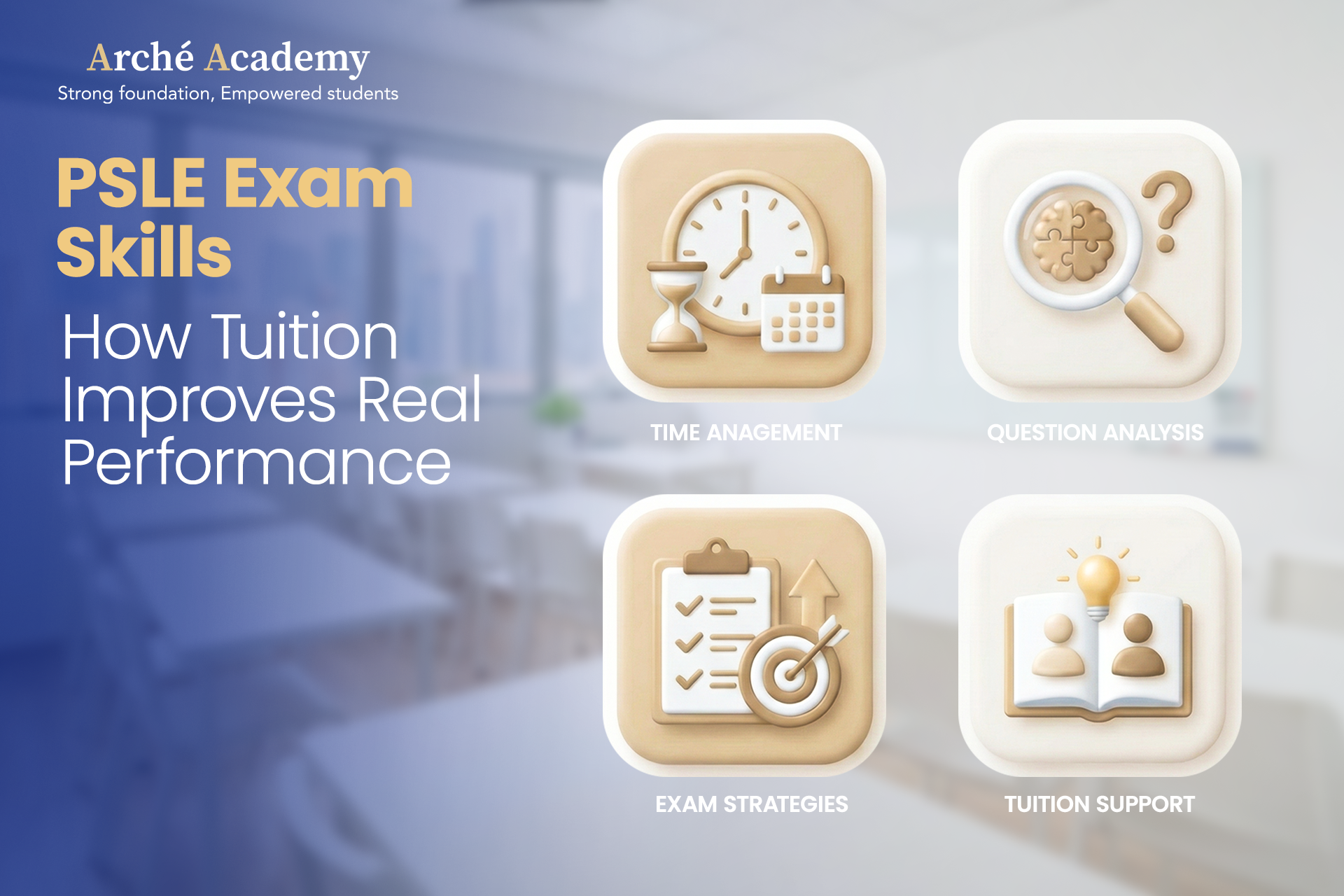
PSLE exam skills often decide outcomes more than subject knowledge alone. This blog will walk you through how PSLE tuition develops exam-specific skills schools do not explicitly teach, why these skills matter under national marking standards, and how targeted preparation changes performance even when content knowledge stays the same.
Why PSLE Exam Skills Matter More Than Parents Realise

Many parents assume PSLE performance is a direct reflection of how much a student knows. In practice, it reflects how effectively a student can use what they know within exam constraints.
The Primary School Leaving Examination is designed and administered under national standards set by the Ministry of Education and the Singapore Examinations and Assessment Board. These standards reward precision, clarity, and consistency. They do not reward effort, familiarity, or volume of practice.
This gap between knowledge and performance is where PSLE exam skills become decisive.
What Schools Teach Well, and What They Cannot Prioritise

Curriculum Delivery Is the School’s Core Mandate
Primary schools focus on syllabus coverage, concept understanding, and broad assessment exposure. Teachers manage large classrooms and must ensure every topic is taught within a fixed academic calendar.
This system works for building foundations. It is not designed to train micro-level exam behaviours.
Why Exam Skills Are Often Implicit, Not Explicit
Skills such as interpreting question intent, structuring answers for marks, or managing time across sections are often demonstrated briefly, not systematically drilled. Teachers assume these skills develop naturally with maturity.
For some students, they do. For many others, they do not.
What PSLE Exam Skills Actually Are
Exam Skills Are Not “Tricks”
PSLE exam skills are repeatable behaviours aligned with how papers are set and marked. They include:
- Question interpretation accuracy
- Alignment with marking logic
- Time management under pressure
- Answer precision
These skills can be taught, practised, and refined deliberately.
Why Content Knowledge Alone Plateaus
Students often reach a point where:
- They understand the topic
- They can solve questions slowly
- They still lose marks consistently
At this stage, more worksheets do not help. Skill intervention does.
How PSLE Tuition Trains Question Interpretation
Reading for Task, Not Topic
Many PSLE questions look familiar but require a different response each time. Tuition trains students to identify:
- What the question is actually asking
- What information is relevant
- What must be excluded
This reduces misinterpretation, one of the most common causes of lost marks.
Recognising Instruction Keywords
Words such as “explain”, “state”, “show”, or “compare” signal different marking expectations. Tuition makes these signals explicit and trains students to adjust responses accordingly.
Schools rarely isolate this skill due to time constraints.
Teaching Marking Logic Explicitly
How Markers Award Credit
Markers follow structured rubrics. They look for:
- Specific working steps
- Clear reasoning statements
- Direct answers that match the task
Tuition exposes students to this logic early so answers are constructed for marks, not just correctness.
Why “Correct but Uncredited” Happens
Students often arrive at the right answer but skip steps or write unclearly. Under PSLE marking, incomplete communication results in partial or zero credit.
This is not harshness. It is standardisation.
Time Management as a Trainable Skill
Why Many Students Run Out of Time
Time pressure increases cognitive load. Students who:
- Over-invest in early questions
- Freeze on unfamiliar formats
- Skip planning steps
often underperform despite understanding the material.
How Tuition Builds Timing Awareness
PSLE tuition trains:
- Section pacing
- Decision-making on when to move on
- Prioritisation under time constraints
These behaviours are practised deliberately, not assumed.
Exam Precision and Answer Control
Precision Beats Length
Long answers do not score more marks. Precise answers do.
Tuition teaches students to:
- Write only what earns marks
- Avoid unnecessary explanation
- Use keywords aligned with marking points
This improves clarity and reduces careless loss.
Eliminating Avoidable Errors
Careless mistakes are rarely careless. They come from rushed processing or unclear thinking. Tuition slows students down at the right moments and speeds them up where it is safe.
Subject-Specific Exam Skill Development
English: Controlling Interpretation and Expression
In PSLE English, exam skills include:
- Interpreting comprehension questions accurately
- Selecting evidence instead of paraphrasing blindly
- Structuring situational writing logically
These are not vocabulary problems. They are response-control problems.
Mathematics: Method Visibility
In Mathematics, students lose marks when working is unclear. Tuition trains students to present solutions in a way markers can follow easily, even under time pressure.
Correct thinking must be visible to earn credit.
Why These Skills Improve Results Without More Content
Skill Training Raises the Floor
Exam skills reduce volatility. Students perform closer to their true ability more consistently. This matters under standards-based scoring.
Confidence Comes From Control
When students know how to approach papers, anxiety drops. Confidence follows preparation, not reassurance.
This is why families often explore structured academic pathways through academic classes in Singapore rather than relying on volume-based practice alone.
How to Tell If a Student Needs Exam Skill Support
Warning Signs Parents Often Miss
Look for patterns such as:
- Frequent “I know but I ran out of time”
- Correct answers with lost marks
- Strong homework performance but weak exam results
These indicate exam skill gaps, not content gaps.
When Tuition Adds Real Value
Tuition is most effective when it:
- Diagnoses specific exam behaviours
- Targets repeatable weaknesses
- Reviews impact over time
Random practice does not achieve this.
The Role of Parents in Supporting Exam Skill Development
Parents do not need to teach exam skills directly. They support by:
- Encouraging reflection after tests
- Focusing on process, not just scores
- Avoiding last-minute panic-driven changes
Consistency matters more than intensity.
Conclusion
Skills for the PSLE exam fill the gap between knowing and getting a good score. Schools lay the groundwork, but tuition teaches students how to use what they’ve learned in a test setting.
If your child understands the material but has trouble turning effort into results, look into how Arche Academy helps students develop test-specific skills through structured preparation.
FAQs About PSLE Exam Skills
What are PSLE exam skills?
PSLE exam skills include question interpretation, alignment with marking logic, time management, and answer precision required under national assessment standards.
Can exam skills be taught?
Yes. These skills are trainable behaviours that improve with deliberate practice and feedback.
Why don’t schools focus more on exam skills?
Schools prioritise syllabus delivery and broad readiness. Detailed exam skill training requires individualised attention.
Does exam skill training reduce stress?
Yes. Students who understand exam structure and expectations experience lower anxiety during assessments.
When should exam skill training begin?
Ideally from upper Primary 5, once foundational concepts are stable and exam formats become more demanding.